
Mazda CX-5 Service & Repair Manual: Efficient Removal Of Body Panels
Body Measurements
-
Before removal or rough?cutting, first measure the body at and around the damaged area against the standard reference dimension specifications. If there is deformation, use frame repair equipment to make a rough correction.
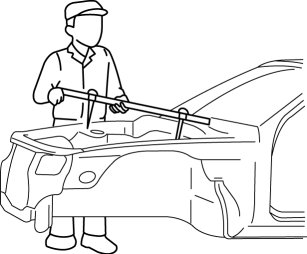
Prevention of Body Deformation
-
Use a clamp or a jack for removal and reinforce at and around the rough?cutting location to prevent deforming of the body.
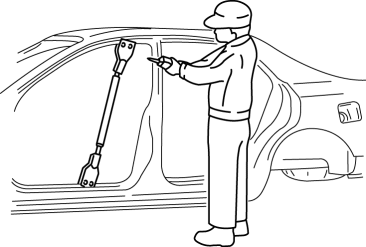
Selection of Cut?and?join Locations
-
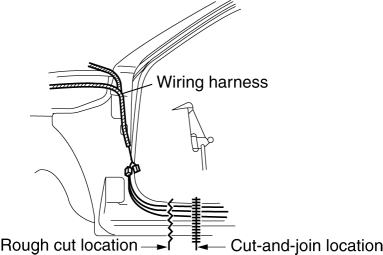
For parts where complete replacement is not feasible, careful cutting and joining operations should be followed. If the location to be cut is a flat area where there is no reinforcement, the selected cutting location should be where the welding distortion will be minimal.
Removal of Associated Parts
-
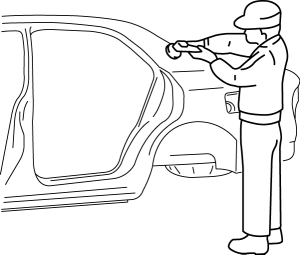
Protect moldings, garnishes, and ornaments with tape when removing associated parts.
Rough Cutting of Damaged Panel
-
Verify that there are no parts (such as pipes, hoses, and wiring harness) nearby or on the opposite side of a panel which could be damaged by heat.
-
For cut?and?join areas, allow for an overlap of 30—50 mm {1.2—1.9 in} and then rough?cut the damaged panel.
 Efficient Installation Of Body Panels
Checking Preweld Measurements And Watching
Align to the standard reference dimensions, based upon the body dimensions
illustration, so that new parts are installed in the correct position.
...
 Energy Absorbing Form Removal/Installation
1. Disconnect the negative battery cable..
2. Remove the seal board upper..
3. Remove the front bumper..
4. Insert the flathead screwdriver shown in the figure, push fasteners A for
back side ...
Other materials:
Front Door Key Cylinder Switch Inspection
1. Perform the front door glass preparation..
2. Disconnect the negative battery cable..
3. Remove the following parts:
a. Inner garnish.
b. Front door trim.
c. Front door key cylinder.
d. Front door glass.
e. Front door module panel.
f. Front door latch and lock actuator.
Front Do ...
Rear Body Control Module (Rbcm)
Outline
Positioned at the rear of the vehicle, the rear body control module (RBCM)
performs numerous system controls for functions at the vehicle rear.
Function
The rear body control module (RBCM) controls the system based on the input/output
signals.
The functions ...
Map Light Removal/Installation
Front Map Light
1. Disconnect the negative battery cable..
2. Open the sunglasses holder.
3. Remove the screws from the front map light.
4. Move the front map light in the direction of the arrow (1) shown in the figure
and pull out the pin from the bracket.
CAUTION:
Be careful ...
