
Mazda CX-5 Service & Repair Manual: Differential Oil Replacement
1. Place the vehicle on level ground.
2. Remove the filler plug.
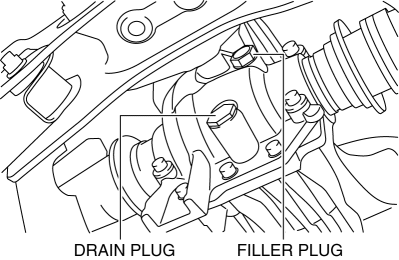
3. Remove the drain plug and drain the differential oil into a container.
4. Install a new washer and the drain plug, and tighten.
-
Tightening torque
-
40—53 N·m {4.1—5.4 kgf·m, 30—39 ft·lbf}
5. Add the specified differential oil from the filler plug until the level reaches the brim of the plug hole.
-
Rear differential oil
-
Specified oil grade: API service GL-5
-
Specified oil viscosity: SAE 80W-90
-
Capacity (approx. quantity): 0.45 L {0.48 US qt, 0.40 Imp qt}
6. After filling with differential oil, perform oil level inspection.
7. Install a new washer and the drain plug, and tighten.
-
Tightening torque
-
40—53 N·m {4.1—5.4 kgf·m, 30—39 ft·lbf}
 Differential Oil Inspection
1. Place the vehicle on level ground.
2. Remove the filler plug and washer.
3. Verify that the oil is at the brim of the filler plug hole.
4. If it is low, add the specified oil.
5. Instal ...
 Differential Oil Temperature Sensor
Purpose, Function
The differential oil temperature sensor detects the rear differential oil
temperature based on the resistance of the thermistor, and inputs it to the
AWD CM.
Const ...
Other materials:
Front Outer Handle Removal/Installation
1. Perform the front door glass preparation..
2. Disconnect the negative battery cable..
3. Remove the following parts:
a. Inner garnish.
b. Front door trim.
c. Front door glass.
d. Front door module panel.
e. Front door key cylinder.
4. Disconnect the keyless antenna connector (With ...
Child-Restraint System Installation
Child-Restraint System Types
In this owner's manual, explanation of child-restraint systems is provided for
the following three types of popular childrestraint systems: infant seat, child
seat, booster seat.
NOTE
• Installation position is determined
by the type of child-restraint sys ...
Airflow Mode Control [Full Auto Air Conditioner]
Purpose
The airflow mode control changes the airflow mode according to the vehicle
environment.
Function
The airflow mode control drives the airflow mode actuator according to the
mode switch, defroster switch, and the vehicle environment and switches the
position of the ...
