
Mazda CX-5 Service & Repair Manual: High Pressure Fuel Pump Control
Outline
-
Changes the fuel pressure applied to the fuel injector according to engine operation conditions to improve engine output and startability.
-
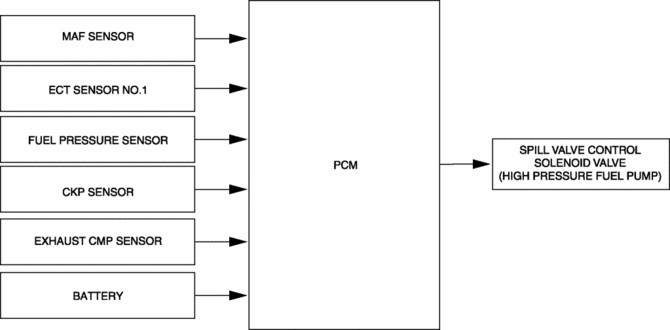
The PCM determines the fuel pressure value corresponding to the engine operation conditions based on the each input signal, and drives the spill valve control solenoid valve for optimum control of fuel pressure.
Block Diagram
OPERATION
Directly after engine start
-
During a cold engine start, the fuel pressure is raised to promote fuel atomization.
Basic Control
-
The PCM determines the target fuel pressure according to charging efficiency and performs feedback control by monitoring the fuel pressure in the fuel delivery pipe using the fuel pressure sensor.
-
When idling after engine warm up: Approx. 3 MPa {31 kgf/cm2, 435 psi}
-
After engine warm up, engine speed is 3,000 rpm or more, charging efficiency is 60 % or more: Approx. 15.0 MPa {153 kgf/cm2, 2176 psi}
 Fuel Tank
Purpose, Function
Store fuel safely and supply fuel to the engine.
Construction
U.S.A. and CANADA
The fuel tank is installed below the rear seat.
2WD
AWD
T ...
 High Pressure Fuel Pump Inspection
NOTE:
The following vacuum values are indicated by relative pressure from the fuel
pressure sensor.
1. Verify that the fuel pressure sensor is normal..
2. Connect the M-MDS to the D ...
Other materials:
Engine Mount
Purpose, Function
The engine mount secures the engine and transaxle to the vehicle body, reducing
vibration and noise.
Construction
The three points at the engine front (No.3 engine mount), one side of the
transaxle (No.1 engine mount), and the rear upper part of the transa ...
Units
Electric current
A (ampere)
Electric power
W (watt)
Electric resistance
ohm
Electric voltage
V (volt)
Length
mm (millimeter)
in (inch)
...
Engine
Special Features
For SKYACTIV-G 2.0, the following is performed to lower fuel consumption.
Improvement of mechanical resistance loss
Narrowed down crankshaft journal
Optimized piston skirt shape
Lowered piston ring tension
...
