
Mazda CX-5 Service & Repair Manual: Throttle Position (TP) Sensor Inspection
Voltage Inspection
CAUTION:
-
The inspection cannot be performed with this method correctly if there is a malfunction of the APP sensor or throttle valve actuator. Verify that no DTCs related to the APP sensor or throttle valve actuator are stored before the inspection.
NOTE:
-
The TP sensor cannot be removed as a single unit. When replacing the TP sensor, replace it together with the throttle body as a single unit.
1. Connect the M-MDS to the DLC?2.
2. Switch the ignition ON (engine off or on).
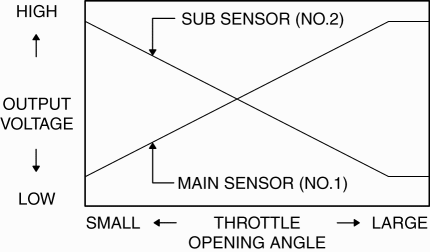
3. Verify that the TP sensor output voltage (PID: TP1, TP2) varies according to the accelerator opening angle when the accelerator opening angle is gradually increased..
-
If verified, go to the next step.
-
If not as verified, replace the throttle body..
4. Verify that the TP sensor output voltage (PID: TP1, TP2) is within the specification when the accelerator pedal is depressed and not depressed..
-
If not as specified, replace the throttle body..
Specification
 Throttle Body
Purpose, Function
Opens/closes the throttle valve to adjust the amount of air supplied to the
cylinder.
Opens/closes the throttle valve according to the control signal from the
PC ...
 Throttle Position (TP) Sensor
Purpose/Function
Detects the throttle valve opening/closing condition, which operates in accordance
with the accelerator pedal operation, as basic information for mainly determining
the f ...
Other materials:
PID/Data Monitor Inspection [Adaptive Front Lighting System (Afs)]
1. Connect the M-MDS to the DLC-2.
2. After the vehicle is identified, select the following items from the initialization
screen of the M-MDS.
a. Select “DataLogger”.
b. Select “Modules”.
c. Select “AFS”.
3. Select the applicable PID from the PID table.
4. Verify the PID da ...
Seat Belt Warning Alarm
Purpose
The seat belt warning alarm warns occupants that a seat belt is not fastened.
Function
The instrument cluster sounds the seat belt warning alarm based on the following
CAN signals:
Vehicle speed signal sent from PCM
Driver/passenger buckle switc ...
Front Door Key Cylinder Switch Inspection
1. Perform the front door glass preparation..
2. Disconnect the negative battery cable..
3. Remove the following parts:
a. Inner garnish.
b. Front door trim.
c. Front door key cylinder.
d. Front door glass.
e. Front door module panel.
f. Front door latch and lock actuator.
Front Do ...
