
Mazda CX-5 Service & Repair Manual: Rear Stabilizer Control Link Inspection
1. Remove the rear stabilizer control link..
2. Inspect for bending or damage. If there is any malfunction, replace the rear stabilizer control link.
3. Rotate the ball joint stud 10 times
and shake it side to side 10 times
.
4. Measure the ball-joint rotational torque using an Allen wrench and a torque wrench.
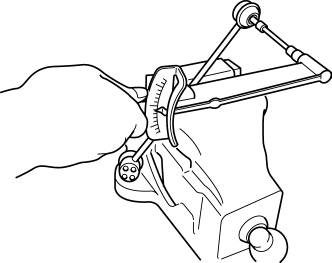
-
Rear stabilizer control link ball joint starting torque
-
0.8—3.5 N·m {8.2—35 kgf·cm, 7.1—30 in·lbf}
-
If not within the specification, replace the rear stabilizer control link.
-
Even when within the specification, if there is excessive play in the ball joint, replace the rear stabilizer control link.
 Rear Shock Absorber Removal/Installation
1. Remove in the order indicated in the table.
2. Install in the reverse order of removal.
1
Rear shock absorber upper nut
(See Rear Shock Absorber Upper nut Install ...
 Rear Stabilizer Removal/Installation [2 Wd]
WARNING:
Verify that the rear crossmember is securely supported by a jack. If the
rear crossmember falls off, it can cause serious injury or death, and damage
to the vehicle.
C ...
Other materials:
Fuel Draining Procedure
WARNING:
Fuel line spills and leakage from the pressurized fuel system are dangerous.
Fuel can ignite and cause serious injury or death and damage. To prevent this,
complete the following inspection with the engine stopped.
Fuel is very flammable liquid. If fuel spills or leaks ...
Rear Stabilizer Removal/Installation [Awd]
WARNING:
Verify that the rear crossmember is securely supported by a jack. If the
rear crossmember falls off, it can cause serious injury or death, and damage
to the vehicle.
CAUTION:
Performing the following procedures without first removing the rear ABS wheel-spee ...
Manual Transaxle Operation
Manual Transaxle Shift Pattern
The shift pattern of the transaxle is conventional, as shown.
Depress the clutch pedal all the way down while shifting; then release it slowly.
Your vehicle is equipped with a device to prevent shifting to R (reverse) by
mistake.
Push the shift lever downward a ...
