
Mazda CX-5 Service & Repair Manual: Rear Sash Molding Installation
WARNING:
-
Using a utility knife with bare hands can cause injury. Always wear gloves when using a utility knife.
NOTE:
-
Double-sided adhesive tape has already been attached to the new rear sash molding.
1. When installing a new rear sash molding, follow the procedure below:
a. Carefully remove the adhesive remaining on the body using a razor blade.
b. Remove any grease or dirt from the adhesion surface of the body.
2. Remove the adhesive remaining on the rear sash molding and the body using a razor blade.
a. Remove any grease or dirt from the adhesion surface of the rear sash molding and the body.
b. Apply primer to the bonding area of the rear sash molding.
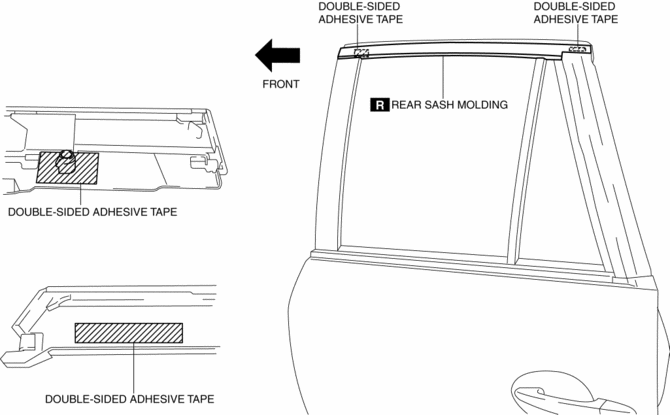
c. Affix double-sided adhesive tape to the rear sash molding as shown in the figure.
NOTE:
-
As for the double-sided adhesive tape, use 3M GT7120 or equivalent.
3. Peel off the backing of the double-sided adhesive tape.
4. Hook tab A to the body in the position where clip B aligns with the sash holes.
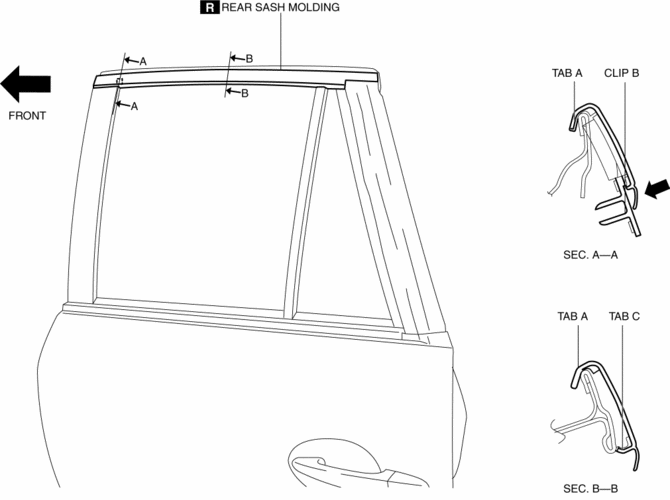
5. Press the rear sash molding in the direction of the arrow and install clip B to the body.
CAUTION:
-
Do not press the rear sash molding in any place other than the rubber areas.
6. Press the rear sash molding from the vehicle front in the direction of the arrow and install tab C.
NOTE:
-
After installing the rear sash molding, verify that tabs A and C are connected properly to the body.
 Rear Over Fender Removal/Installation
1. Remove fasteners A.
2. Pull the rear over fender in the direction of the arrow while removing clips
B.
3. Install in the reverse order of removal. ...
 Rear Sash Molding Removal
WARNING:
Using a utility knife with bare hands can cause injury. Always wear gloves
when using a utility knife.
1. Remove the rear door garnish. (rear side).
2. Remove the double-si ...
Other materials:
Power Seat System
Outline
The power seat system drives the electric motor, operates the front seat
safely, and changes the driving posture to suit the occupant by operating the
power seat switch.
8 way power seats or 6 way power seats have been adopted on the driver's
seat.
Function
...
Instrument Cluster Operation Record
Purpose
The instrument cluster operation record stores the record of the illumination
or flashing of the warning light.
Function
The operation record is stored by the instrument cluster and displayed using
the Mazda Modular Diagnostic System (M-MDS).
The instrument ...
Air Intake Actuator Inspection [Full Auto Air Conditioner]
1. Connect battery positive voltage to air intake actuator terminal B (or C),
connect terminal C (or B) to ground, and then verify that the air intake actuator
operates as shown in the table.
If the operation condition is not normal, replace the air intake actuator.
...
