
Mazda CX-5 Service & Repair Manual: Hood Latch Switch
Purpose
-
Detects the open/closed condition of the hood.
Function
-
The hood latch switch is utilized in the theft-deterrent system control.
-
For the theft-deterrent system, refer to (see THEFT-DETERRENT SYSTEM.).
Construction
-
Built into the hood latch.
-
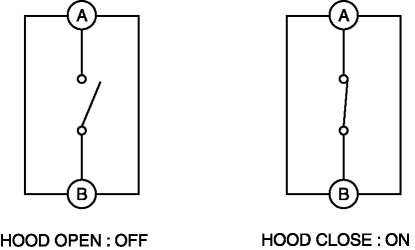
Switch turns on and off by the rotation of the latch bar.
-
When the hood is completely closed, the hood latch switch is on (contact point: closed).
Operation
Hood close (latch) operation
1. When the hood is closed, the hood lock striker enters the latch lever groove.
2. When the hood is then further closed, the latch lever is pressed by the hood lock striker and rotates.
3. When the hood is completely closed, the latch lever is in a latched condition and presses the hood latch switch which turns the switch on.
Hood open (unlatch) operation
1. When the hood release lever is pulled, the hood opens and the latch lever is in an unlatched condition, and the hood latch switch turns off.
Fail-safe
-
Function not equipped.
 Hood Latch And Release Lever Removal/Installation
Hood Latch
1. Open the hood.
2. Disconnect the negative battery cable..
3. Remove the front bumper..
4. Insert a tape-wrapped flathead screwdriver into the position shown in the
figure.
...
 Hood Latch Switch Inspection
1. Disconnect the negative battery cable..
2. Remove the front bumper..
3. Disconnect the hood latch switch connector..
4. Verify that the continuity is as indicated in the table.
NOTE:
...
Other materials:
Differential Oil Temperature Sensor
Purpose, Function
The differential oil temperature sensor detects the rear differential oil
temperature based on the resistance of the thermistor, and inputs it to the
AWD CM.
Construction
The differential oil temperature sensor is installed in the rear differential
carr ...
Automatic Transaxle Outline [Fw6 A EL, Fw6 Ax EL]
Outline
Contribution to low fuel economy
Wide TCC range
Clutch/brake resistance reduction
Realized direct feel and quick shifting
Oil passage resistance reduction and improved clutch/brake response
b ...
Lift Motor Inspection
WARNING:
Handling a side air bag improperly can accidentally operate (deploy) the
air bag, which may seriously injure you. Read the service warnings/cautions
in the Workshop Manual before handling the front seat (side air bag integrated)..
1. Disconnect the negative battery cable ...
