
Mazda CX-5 Service & Repair Manual: Climate Control Unit Inspection [Manual Air Conditioner]
1. Remove the climate control unit with the connector connected..
2. Switch the ignition ON (engine off or on).
3. Connect the negative (-) lead of the tester to the body ground.
4. By inserting the positive (+) lead of the tester into the climate control unit connector, measure the voltage according to the terminal voltage table.
-
If there is any malfunction, inspect the parts under “Inspection item(s)”.
-
If the parts under “Inspection item(s)” are normal, replace the climate control unit.

Terminal Voltage Table (Reference)
|
Terminal |
Signal name |
Connected to |
Measurement condition |
Voltage (V) |
Inspection item(s) |
|
A |
TNS signal |
Front body control module (FBCM) |
TNS OFF |
1.0 or less |
|
|
TNS ON |
B+ |
||||
|
B |
Illumination (-) |
Instrument cluster |
Headlight ON and panel light control MAX |
2.0 |
|
|
Headlight ON and panel light control MIN |
9.65 |
||||
|
C |
Motor operation |
Air intake actuator |
Switched to RECIRCULATE |
B+ |
|
|
Switched to FRESH |
1.0 or less |
||||
|
D |
Ground |
Body ground |
Under any condition |
1.0 or less |
|
|
E |
Motor operation |
Air intake actuator |
Switched to RECIRCULATE |
1.0 or less |
|
|
Switched to FRESH |
B+ |
||||
|
F |
Sensor GND |
Evaporator temperature sensor |
Under any condition |
1.0 or less |
|
|
G |
Blower fan ON/OFF signal |
Fan switch |
Fan stopped |
B+ |
|
|
Fan on |
1.0 or less |
||||
|
H |
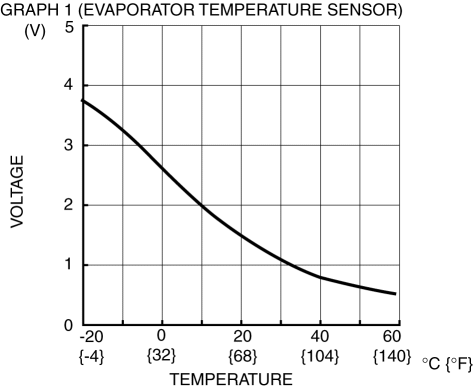
Evaporator temperature sensor input |
Evaporator temperature sensor |
Compared with temperature detected by evaporator temperature sensor |
Refer to graph 1 |
|
|
I |
Blower fan position signal |
Fan switch |
3rd, 4th |
1.0 or less |
|
|
off, 1st, 2nd |
B+ |
||||
|
J |
B+ |
ROOM 15 A fuse |
Under any condition |
B+ |
|
|
K |
LIN |
Front body control module (FBCM) |
Because this terminal is for communication, good/no good judgment by terminal voltage is not possible. |
|
|
|
L |
IG2 |
Front body control module (FBCM) |
Switch the ignition to ON |
B+ |
|
|
Switch the ignition off |
1.0 or less |
||||
 Climate Control Unit Inspection [Full Auto Air Conditioner]
1. Remove the climate control unit with the connector connected..
2. Switch the ignition ON (engine off or on).
3. Connect the negative (-) lead of the tester to body ground.
4. By inserting the ...
 Climate Control Unit Removal/Installation [Full Auto Air Conditioner]
NOTE:
The climate control unit prior to replacement stores the vehicle specification
information.
The new climate control unit does not store any vehicle specification information.
...
Other materials:
Warranties for Your Mazda
• New Vehicle Limited Warranty
• Powertrain Limited Warranty
• Safety Restraint System Limited Warranty
• Anti-perforation Limited Warranty
• Federal Emission Control Warranty/California
Emission Control Warranty
• Emission Defect Warranty
• Emission Performance Warranty
• E ...
Units
Electric current
A (ampere)
Electric power
W (watt)
Electric resistance
ohm
Electric voltage
V (volt)
Length
mm (millimeter)
in (inch)
...
Engine Oil Solenoid Valve
Purpose, Function
The engine oil solenoid valve switches the hydraulic transmission passage
in accordance with the driving conditions and the oil pump drive resistance
is reduced by controlling oil pump discharging pressure in two steps.
Construction
The engine oil solenoid ...
