
Mazda CX-5 Service & Repair Manual: Air Bag System Service Cautions [Standard Deployment Control System]
Air Bag System Component Disassembly
-
Disassembling the air bag system components could cause it to not operate (deploy) normally. Never disassemble any air bag system components.
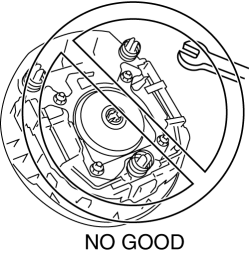
Air Bag Module, Pre-tensioner Seat Belt Handling
-
Oil, grease, or water on the air bag modules may cause the air bags to fail to operate (deploy) in an accident. Never allow oil, grease, or water to get on the air bag modules.
-
Inserting a screwdriver or similar object into the connector of an air bag module or pre-tensioner seat belt may damage the connector and cause the air bag module or pre-tensioner seat belt to operate (deploy) improperly, which may cause serious injury. Never insert any foreign objects into the air bag module or pre-tensioner seat belt connectors.
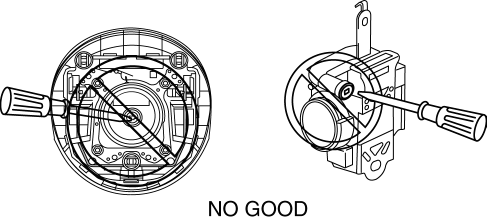
Air Bag Module, Pre-tensioner Seat Belt Reuse
-
Even if an air bag module or pre-tensioner seat belt does not operate (deploy) in a collision and does not have any external signs of damage, it may have been damaged internally, which may cause improper operation. Before reusing a live (undeployed) air bag module or pre-tensioner seat belt always use the on-board diagnostic to diagnose the air bag module or pre-tensioner seat belt to verify that they have no malfunction.
Air Bag Wiring Harness Repair
-
Incorrectly repairing an air bag wiring harness can accidentally operate (deploy) the air bag modules or pre-tensioner seat belts. If a problem is found in the air bag wiring harness, always replace the wiring harness with a new one.
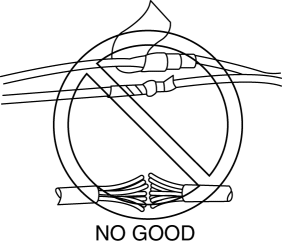
 Air Bag Module And Pre Tensioner Seat Belt Disposal Procedures [Two Step Deployment
Control System]
Air Bag Module And Pre Tensioner Seat Belt Disposal Procedures [Two Step Deployment
Control System]
WARNING:
A live (undeployed) air bag module, pre-tensioner seat belt or lap pre-tensioner
seat belt may accidentally operate (deploy) when it is disposed of and cause
serious injury. Alw ...
 Air Bag System Service Cautions [Two Step Deployment Control System]
Air Bag System Component Disassembly
Disassembling the air bag system components could cause it to not operate
(deploy) normally. Never disassemble any air bag system components.
...
Other materials:
Low Fuel Warning Light
Purpose
The low fuel warning light warns the driver that the remaining fuel level
is low.
Function
The instrument cluster calculates the fuel quantity based on the following
CAN signals, and if a remaining fuel amount of approx. 10 L {2.6 US gal, 2.2
Imp gal} (fuel gauge ...
Air Bag System Warning Light [Standard Deployment Control System]
Purpose
The air bag system warning light notifies the driver of a malfunction in
the SRS air bag system.
Function
If a malfunction occurs in the SRS air bag system, the air bag system warning
light illuminates or flashes.
Construction
LEDs (light-emitting d ...
Windshield Wiper And Washer Switch Inspection
1. Disconnect the negative battery cable..
2. Remove the following parts:
a. Column cover.
b. Wiper and washer switch.
3. Use a tester to measure and verify that the continuity between the windshield
wiper and washer switch terminals is as indicated in the table.
If the continu ...
