
Mazda CX-5 Service & Repair Manual: Non Return Valve Inspection
WARNING:
-
Fuel is very flammable liquid. If fuel spills or leaks from the pressurized fuel system, it will cause serious injury or death and facility breakage. Fuel can also irritate skin and eyes. To prevent this, always complete the “Fuel Line Safety Procedure”, while referring to the “BEFORE SERVICE PRECAUTION”.
-
A person charged with static electricity could cause a fire or explosion, resulting in death or serious injury. Before draining fuel, make sure to discharge static electricity by touching the vehicle body.
1. Complete the “BEFORE SERVICE PRECAUTION”..
2. Disconnect the negative battery cable..
3. Using the following procedure:
-
6:4 split type
-
Remove the rear seat cushion..
-
4:2:4 split type
-
Set the rear seat aside as shown in the figure..
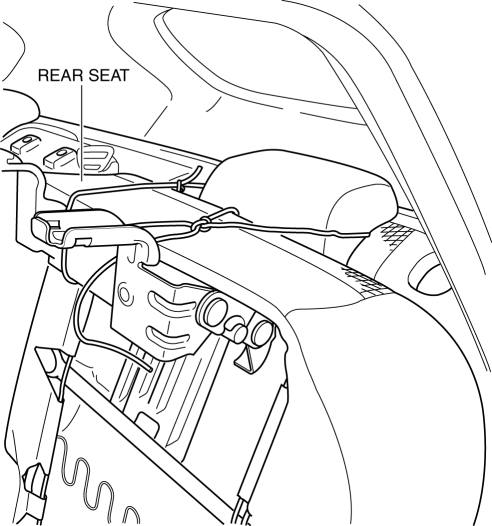
4. Remove the fuel pump unit..
5. Drain the fuel from the fuel tank to the position where the non-return valve is visible..
NOTE:
-
Non-return valve is integrated in the fuel tank.
-
The non-return valve is normally closed by the spring force.
6. Verify that the non-return valve is closed.
-
If the non-return valve is stuck open and does not open even when pulled up by a finger, replace the fuel tank..
 Miller Cycle Engine
Outline
The Miller cycle engine is a high-efficiency engine which achieves high fuel
economy performance by obtaining a high-expansion ratio.
The Miller cycle engine achieves a high- ...
 Non Return Valve
Purpose, Function
Assures safety by preventing fuel from returning to the fuel filler opening.
Construction
The non-return valve cannot be removed as it is installed inside the fue ...
Other materials:
Rear View Monitor
Rear View Monitor
The rear view monitor is a visual assist system when reversing the vehicle that
provides images from the rear of the vehicle.
WARNING
Always drive carefully confirming the safety of the rear and the surrounding
conditions by looking directly with your eyes:
Reversing the ve ...
Air Bag System Service Cautions [Standard Deployment Control System]
Air Bag System Component Disassembly
Disassembling the air bag system components could cause it to not operate
(deploy) normally. Never disassemble any air bag system components.
Air Bag Module, Pre-tensioner Seat Belt Handling
Oil, grease, or water on the air bag modules ...
Manual Transaxle Removal/Installation [C66 M R]
Removal
1. Disconnect the negative battery cable..
2. Remove the plug hole plate..
3. Remove the front under cover No.2..
4. Remove the front under cover No.1..
5. Remove the splash shield..
6. Drain the manual transaxle oil..
7. Disconnect and/or remove the following parts in the engin ...
