
Mazda CX-5 Service & Repair Manual: Master Cylinder
Purpose/Function
-
With the adoption of the master cylinder having an enlarged diameter (20.64 mm {0.8126 in}), brake pedal operability has been improved.
-
For vehicles with DSC, the diameter of the pipe between the master cylinder and the DSC HU/CM has been increased, improving response during DSC operation.
Construction
-
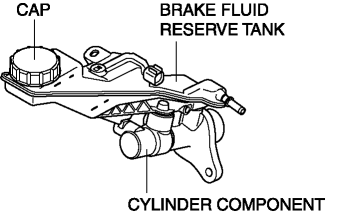
Except for the cap and brake fluid reserve tank, the master cylinder cannot be disassembled. Therefore, if there is any malfunction in the interior of the master cylinder, replace the cylinder component without disassembling.
Operation
-
When the brake pedal is depressed, the push rod of the power brake unit presses in the master cylinder piston. By pressing in the piston, pressure is applied to the brake fluid to operate the brakes.
 Master Cylinder
Purpose/Function
With the adoption of the master cylinder having an enlarged diameter (20.64
mm {0.8126 in}), brake pedal operability has been improved.
For vehicles with DSC, the di ...
 Master Cylinder Removal/Installation
1. Remove the battery..
2. Remove in the order indicated in the table.
3. Install in the reverse order of removal.
4. After installation, add brake fluid, bleed the air, and inspect for fluid
...
Other materials:
Clock Spring Inspection [Standard Deployment Control System]
1. Disconnect the negative battery cable and wait for 1 min or more..
2. Remove the driver?side air bag module..
3. Remove the steering wheel..
4. Remove the column cover..
5. Remove the clock spring..
6. Verify that the continuity is as indicated in the table.
If not as indicated ...
Air Intake Actuator [Manual Air Conditioner]
Purpose
The air intake actuator moves the air intake door in the blower unit to switch
the air intake port.
Function
The air intake actuator drives the motor based on the signal from the climate
control unit and moves the air intake door to the FRESH or REC position.
...
Steering Wheel And Column Removal/Installation
WARNING:
Handling the air bag module improperly can accidentally operate (deploy)
the air bag module, which may seriously injure you. Read the service warnings
and cautions before handling the air bag module..
The steering column (EPS motor) temperature increases directly after ...
