
Mazda CX-5 Service & Repair Manual: Master Cylinder Removal/Installation
1. Remove the battery..
2. Remove in the order indicated in the table.
3. Install in the reverse order of removal.
4. After installation, add brake fluid, bleed the air, and inspect for fluid leakage..
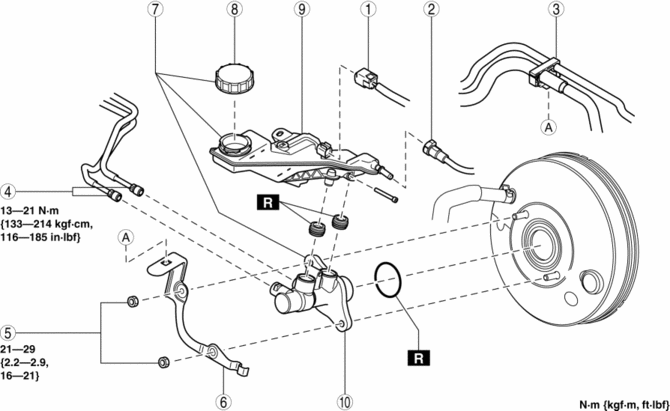
|
1 |
Brake fluid level sensor connector |
|
2 |
Clutch reserve hose (MTX) (See Clutch Reserve Hose Removal Note (MTX).) (See Clutch Reserve Hose Installation Note (MTX).) |
|
3 |
Hose holder |
|
4 |
Brake pipe |
|
5 |
Nut |
|
6 |
Bracket |
|
7 |
Master cylinder |
|
8 |
Cap |
|
9 |
Brake fluid reserve tank |
|
10 |
Cylinder component |
Clutch Reserve Hose Removal Note (MTX)
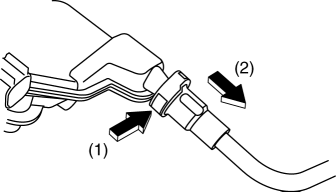
1. Disconnect the clutch reserve hose in the order shown in the figure.
Clutch Reserve Hose Installation Note (MTX)
1. Insert the clutch reserve hose to the master cylinder.
2. Pull the clutch reserve hose to verify that it does not come off, and reinsert it completely.
 Master Cylinder
Purpose/Function
With the adoption of the master cylinder having an enlarged diameter (20.64
mm {0.8126 in}), brake pedal operability has been improved.
For vehicles with DSC, the di ...
 Power Brake Unit
Purpose/Function
A 9.8-inch, single diaphragm type power brake unit has been adopted, achieving
compatibility between high braking performance and excellent brake feeling.
Construction ...
Other materials:
Front Seat Belt Pretensioner and Load Limiting Systems
For optimum protection, the driver and front passenger seat belts are equipped
with pretensioner and load limiting systems. For both these systems to work properly
you must wear the seat belt properly.
Pretensioners:
In moderate or severe frontal or nearfrontal accidents, the front air bag and ...
Fan Switch Inspection [Manual Air Conditioner]
1. Disconnect the negative battery cable..
2. Remove the following parts:
a. Shift lever knob (MTX).
b. Glove compartment.
c. Front console box.
d. Shift panel.
e. Upper panel.
f. Rear console.
g. Side wall.
h. Decoration panel.
i. Front console.
3. Remove the climate control u ...
Front Door Latch And Lock Actuator Removal/Installation
1. Perform the front door glass preparation..
2. Disconnect the negative battery cable..
3. Remove the following parts:
a. Inner garnish.
b. Front door trim.
c. Inner handle.
d. Front door glass.
e. Front door module panel.
f. Front door key cylinder.
4. Remove the door lock knob c ...
