
Mazda CX-5 Service & Repair Manual: Turn And Hazard Indicator Alarm
Purpose
-
The turn and hazard indicator alarm notifies the driver that a turn light or the hazard warning lights are flashing.
Function
-
When the instrument cluster receives the turn signal/hazard warning indicator light illumination request signal sent from the front body control module (FBCM) via the CAN signal, the turn and hazard indicator alarm sounds simultaneously with illumination on/off of the direction/hazard warning indicator lights.
-
The turn and hazard indicator alarm sound pattern is as follows:
|
Sound frequency (Hz) |
Alarm when turn signal/hazard warning indicator lights illumination off > on: 1,400 Alarm when turn signal/hazard warning indicator lights illumination on > off: 1,300 |
|
Sound frequency |
Continuously |
|
Wave pattern |
|
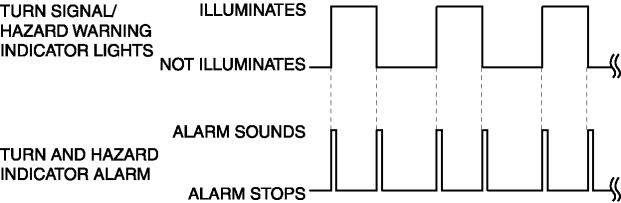
Construction
-
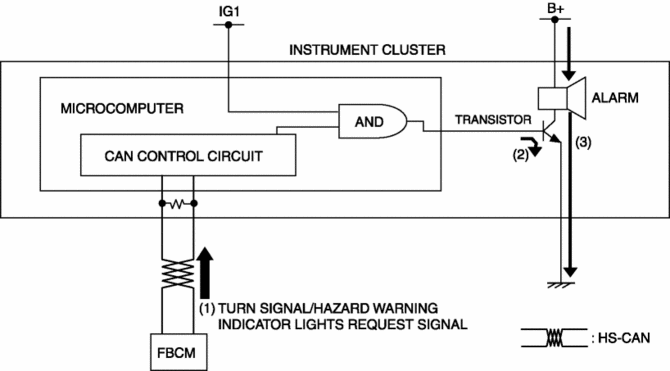
The turn and hazard indicator alarm sounds using the buzzer built into the instrument cluster.
Construction, Operation
1. The instrument cluster receives (1) the turn signal/hazard warning indicator light request signal from the front body control module (FBCM).
2. The instrument cluster microcomputer turns the transistor on (2) based on the turn signal/hazard warning indicator light request signal.
3. When the transistor turns on, a ground circuit with the alarm is established and the alarm sounds (3).
Fail-safe
-
Function not equipped.
 Tire Pressure Monitoring System Warning Light
Purpose, Function
The tire pressure monitoring system warning light notifies the driver that
it was determined that a tire pressure has decreased below the specified value
based on the in ...
 Turn Signal/Hazard Warning Indicator Lights
Purpose
Notifies the driver that a turn light, the hazard warning lights are flashing.
Function
Flashes according to the turn switch and hazard warning switch operations.
Con ...
Other materials:
Refrigerant System Service Warnings
Handling Refrigerant
Avoid breathing air conditioning refrigerant or lubricant vapor. Exposure
may irritate eyes, nose and throat. Also, due to environmental concerns, we
urge use of recovery/recycling/recharging equipment when draining HFC-134a from
the air conditioning system. If a ...
Suspension Features
Improved rigidity and handling stability
A strut type front suspension adopted
E-type multi-link rear suspension adopted
For the front/rear crossmembers, the welded flange has been eliminated
(flange-less), the cross-section expa ...
Generator [Skyactiv G 2.0]
Purpose, Function
The generator operates by obtaining drive force from the engine via the drive
belt and generates the required electricity for electronic devices.
Construction
The generator is installed on the engine left front side.
Output control is perfor ...
