
Mazda CX-5 Service & Repair Manual: Liftgate Latch Switch
Purpose, Function
-
The switch turns on/off in conjunction with the rotation of the latch lever, and it detects the open/closed condition of the liftgate by the voltage value which is changed by the rear body control module (RBCM).
Construction
-
The switch is turned on/off by the rotation of the latch lever.
-
When the liftgate is completely closed, the switch turns off (contact point: Open)
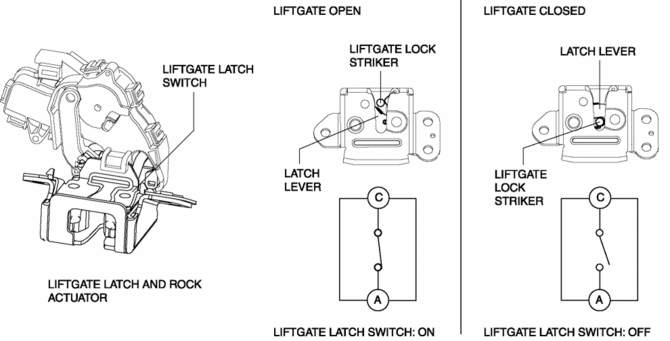
Operation
Liftgate closed (latched) operation
1. When the liftgate is closed, the liftgate lock striker enters the latch lever groove.
2. When the liftgate further closes, the latch lever is pressed by the liftgate lock striker and it rotates.
3. When the liftgate is completely closed, the latch lever is in the latched condition pressing the liftgate latch switch, which turns the switch off.
Liftgate open (unlatch) operation
1. When the liftgate lock actuator operates to open the liftgate, the latch lever is in an unlatched condition, and the liftgate latch switch turns on.
Fail-safe
-
Function not equipped.
 Liftgate Latch And Lock Actuator Removal/Installation
1. Disconnect the negative battery cable..
2. Remove the following parts:
a. Liftgate upper trim.
b. Liftgate side trim.
c. Liftgate lower trim.
3. Disconnect the connector.
4. Remove ...
 Liftgate Latch Switch Inspection
1. Disconnect the negative battery cable..
2. Remove the following parts:
a. Liftgate upper trim.
b. Liftgate side trim.
c. Liftgate lower trim.
d. Liftgate latch and lock actuator.
3. Ver ...
Other materials:
Start Stop Unit Configuration (Using As Built Data)
NOTE:
If the configuration is performed using As-Built data, the set value of the
personalization function is reset to the initial value (condition when shipped
from factory). Verify the set value with the customer and perform the personalization
function setting after performing th ...
Front Door Garnish Removal/Installation
WARNING:
Using a utility knife with bare hands can cause injury. Always wear gloves
when using a utility knife.
1. Using a tape-wrapped fastener remover, remove clips A in the direction of
arrow (1), (2) shown in the figure.
2. Remove the double-sided adhesive tape in the positi ...
Roof Carrier Bracket Removal/Installation
1. Disconnect the negative battery cable..
2. Remove the following parts:
a. Sunroof seaming welt (with sunroof system).
b. A-pillar trim.
c. Front map light.
d. Sunvisor.
e. Front scuff plate.
f. Rear scuff plate.
g. B-pillar lower trim.
h. Adjust anchor cover.
i. Upper anchor i ...
