
Mazda CX-5 Service & Repair Manual: Ion Sensor
Purpose/Function
-
Detects ion generation in the combustion chamber for detecting pre-ignition.
-
Detects ions which occur due to fuel combustion as current by applying bias voltage to the spark plug, which is amplified in the ignition coil internal circuit and input to the PCM.
Construction
-
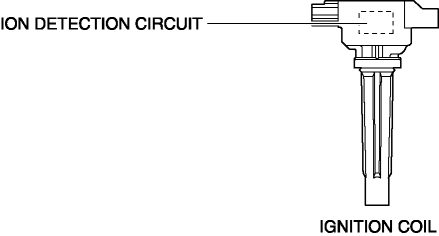
Built into the ignition coil.
Operation
-
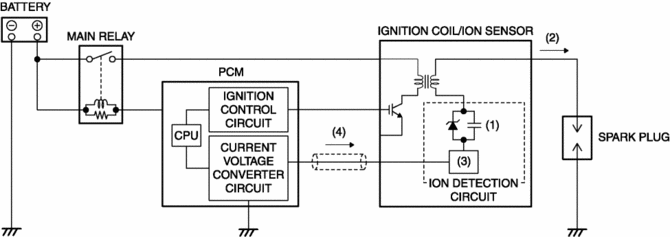
Accumulates the secondary current of the ignition coil in bias condenser (1) and detects ion current (2) by applying the bias voltage to the spark plug.
-
Pulls in current (4) increased by current amplification circuit (3) to the ignition coil from the PCM.
-
The PCM measures/converts the current sent to the ignition coil and monitors.
Ion generation mechanism
-
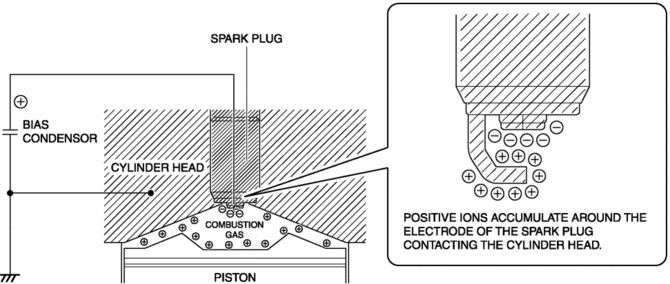
Ions are generated based on: fuel combustion = chemical reaction / disassociation. The generated negative ions move to the center electrode of the spark plug to which bias voltage is applied, positive ions move to the grounded engine wall surface, and then current flows from the spark plug to the ignition coil.
Fail-safe
-
Function not equipped.
 Ion Sensor Inspection
DTC Inspection
1. Connect the M-MDS to the DLC?2.
2. Perform the DTC inspection using the M-MDS..
If any DTC related to the ignition coil/ion sensor is present, repair the
malfunctioning ...
 Lap Pre Tensioner Seat Belt [Two Step Deployment Control System]
Purpose
The lap pre-tensioner seat belts retract and tighten the seat belt webbing
to protect the front passengers during a collision.
Function
The lap pre-tensioner seat belts ...
Other materials:
Heater Core
Purpose
The heater core heats passing air.
Function
A portion of the engine coolant is taken into the heater core to heat the
air passing through the heater core.
Construction
The heater core consists of a tube which passes engine coolant, and the heat
ra ...
Front Body Control Module (Fbcm) Configuration (Using Read/Write Function)
NOTE:
When performing configuration, it is necessary to read the vehicle specification
information from the front body control module (FBCM) before replacing it. Connect
the M-MDS to the vehicle and perform vehicle identification before removing
the front body control module (FBCM). ...
Engine Coolant Replacement
WARNING:
Never remove the cooling system cap or loosen the radiator drain plug while
the engine is running, or when the engine and radiator are hot. Scalding engine
coolant and steam may shoot out and cause serious injury. It may also damage
the engine and cooling system.
Tu ...
