
Mazda CX-5 Service & Repair Manual: Generator Control [Skyactiv G 2.0]
Outline
-
Idling stability has been improved by optimum control of generator voltage according to engine operation and electrical load conditions.
-
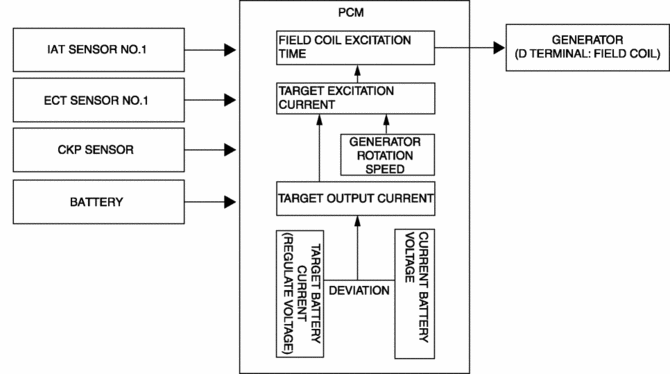
The PCM determines the engine operation and electrical load conditions based on the input signals from each control part and controls the energization time of the generator field coils.
Block Diagram
Operation
Determination method for target excitation current
-
The target excitation current is calculated from the generator target output amount (determined by intake air temperature, engine speed, and vehicle speed), and the actual generator rotation speed.
Determination method for field coil excitation time
-
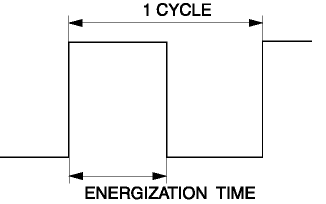
The PCM increases or decreases the field coil excitation current by sending a duty signal to the power transistor built into the generator.
-
The field coil energization current changes according to changes in the power transistor excitation time by changing the duty signal duty ratio. For example, when the battery positive voltage drops, the duty ratio of the duty signal sent to the power transistor is larger, increasing the field coil excitation current.
-
During deceleration fuel-cut, the PCM increases the generator voltage and stores electricity in the battery. At times other than deceleration, the PCM enables electric discharge from the battery to reduce the generator load.
-
Directly after the engine is started, the generator load is decreased by charging only to the necessary level according to the battery conditions in which the battery has not been charged to the maximum.
 Charging System [Skyactiv G 2.0]
Outline
Regulator-less generator (built-in power transistor) has been adopted.
A generator using two delta connection type stator coils has been adopted.
Structural View
Stru ...
 Generator Disassembly/Assembly [Skyactiv G 2.0]
CAUTION:
Melt the solder quickly, otherwise the diodes (rectifier) and regulator will
be damaged by excessive heat.
1. Disassemble in the order indicated in the table.
2. Assemble i ...
Other materials:
Clock Spring Inspection [Two Step Deployment Control System]
1. Disconnect the negative battery cable and wait for 1 min or more..
2. Remove the driver?side air bag module..
3. Remove the steering wheel..
4. Remove the column cover..
5. Remove the clock spring..
6. Verify that the continuity is as indicated in the table.
If not as indicated ...
Fuel Filler Cap
Purpose, Function
Releases evaporative gas from the fuel tank if there is a malfunction in
the evaporative gas passage between the fuel tank and the intake manifold. As
a result, deformation of the fuel tank caused by evaporative gas pressure is
prevented.
Construction
T ...
Intake Air System
Purpose, Outline
A vacuum pump has been adopted which supplies stable vacuum to the power
brake unit.
Structural View
System Diagram
Vacuum Hose Routing Diagram
Structure
The intake air system consists of the following parts:
Part na ...
