
Mazda CX-5 Service & Repair Manual: Fuel Filter (High Pressure) Removal/Installation
WARNING:
-
Fuel is very flammable liquid. If fuel spills or leaks from the pressurized fuel system, it will cause serious injury or death and facility breakage. Fuel can also irritate skin and eyes. To prevent this, always complete the “Fuel Line Safety Procedure”, while referring to the “BEFORE SERVICE PRECAUTION”.
-
A person charged with static electricity could cause a fire or explosion, resulting in death or serious injury. Before draining fuel, make sure to discharge static electricity by touching the vehicle body.
1. Complete the “BEFORE SERVICE PRECAUTION”..
2. Disconnect the negative battery cable..
3. Using the following procedure:
-
6:4 split type
-
Remove the rear seat cushion..
-
4:2:4 split type
-
Set the rear seat aside as shown in the figure..
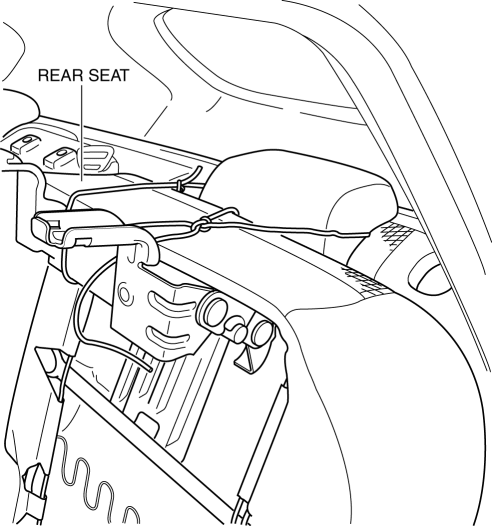
4. Remove the fuel pump unit..
5. Remove the fuel filter (high-pressure)..
6. Install in the reverse order of removal.
7. Complete the “AFTER SERVICE PRECAUTION”..
 Fuel Filler Pipe Removal/Installation
WARNING:
Fuel is very flammable liquid. If fuel spills or leaks from the pressurized
fuel system, it will cause serious injury or death and facility breakage. Fuel
can also irritate skin ...
 Fuel Injection Control System
Outline
Performs optimum fuel injection according to engine operation conditions.
The PCM determines the engine operation conditions based on the signals from
each input device and d ...
Other materials:
Scheduled Maintenance (Mexico)
Follow Schedule 1 if the vehicle is operated mainly where none of the following
conditions apply.
• Repeated short-distance driving
• Driving in dusty conditions
• Driving with extended use of brakes
• Driving in areas where salt or other corrosive
materials are used
• Driving on ...
Rear ABS Wheel Speed Sensor Inspection [Awd]
Installation Visual Inspection
1. Inspect the following items:
If there is any malfunction, replace the applicable part.
a. Excessive play of the ABS wheel-speed sensor
b. Deformation of the ABS wheel-speed sensor
c. Deformation or damage of the ABS sensor rotor
Clearance Inspec ...
Front Drive Shaft
Purpose, Function
A bell joint has been adopted for the wheel-side constant velocity joint,
reducing vibration and noise.
A tripod joint have been adopted for the differential side constant velocity
joint to reduce booming noise during high-speed driving and vibration when idlin ...
