
Mazda CX-5 Service & Repair Manual: Engine Oil Solenoid Valve
Purpose, Function
-
The engine oil solenoid valve switches the hydraulic transmission passage in accordance with the driving conditions and the oil pump drive resistance is reduced by controlling oil pump discharging pressure in two steps.
Construction
-
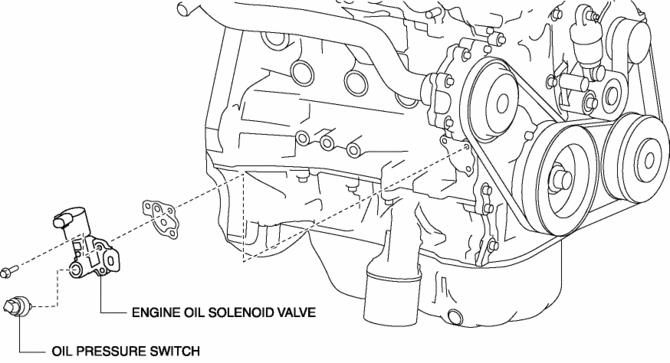
The engine oil solenoid valve is installed on the right side of the cylinder block.
-
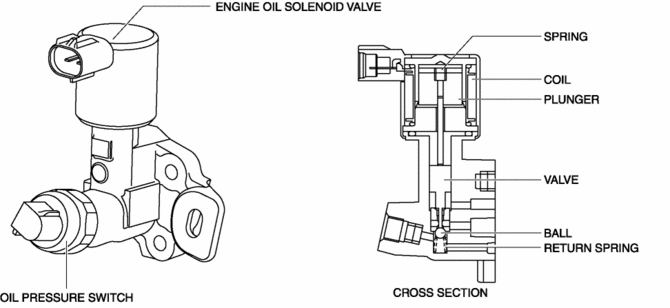
The engine oil solenoid valve has the following parts:
-
A duty drive type has been adopted.
Operation
-
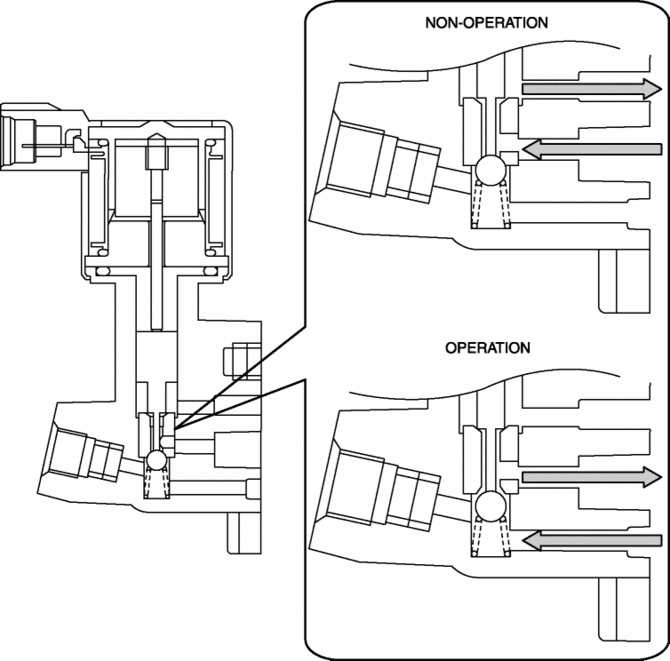
The oil passage in the solenoid valve is switched according to the control signal (duty signal) from the PCM.
Fail-safe
-
Function not equipped.
 Engine Oil Solenoid Valve Removal/Installation
WARNING:
Hot engines and engine oil can cause severe burns. Turn off the engine and
wait until it and the engine oil have cooled.
A vehicle that is lifted but not securely supported ...
 Front Oil Seal Replacement
WARNING:
A hot engine can cause severe burns. Turn off the engine and wait until it
is cool before servicing.
1. Remove the front under cover No.2..
2. Remove the splash shield..
...
Other materials:
Electric Power Steering (Eps) Control Module
Purpose/ Function
The EPS control module (CM) calculates the optimum assist current based on
the steering torque signal from the torque sensor installed to the steering
column and the vehicle speed signal sent via CAN transmission from the PCM.
The EPS CM controls the following ...
Child-Restraint System Installation
Child-Restraint System Types
In this owner's manual, explanation of child-restraint systems is provided for
the following three types of popular childrestraint systems: infant seat, child
seat, booster seat.
NOTE
• Installation position is determined
by the type of child-restraint sys ...
Cooling Fan Relay
Purpose, Function
The cooling fan relay operates by receiving the signal from the PCM to supply
power to the cooling fan motor.
Construction
The cooling fan relay is installed on the relay and fuse block.
Operation
The contact point is on when the battery vo ...
