
Mazda CX-5 Service & Repair Manual: Control Valve Body [Fw6 A EL, Fw6 Ax EL]
Purpose/Function
-
A direct linear solenoid has been adopted for the solenoid valve which contributes to improved shift response, drive feel and reduced shift shock by the improved precision of the hydraulic pressure control.
Construction
-
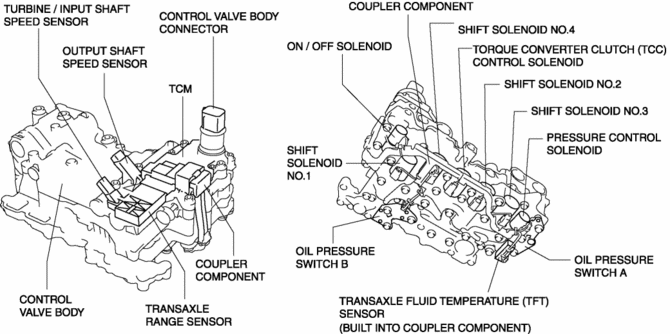
The control valve body consists of integrated hydraulic control related parts and electronic control related parts.
-
The transaxle range sensor, output shaft speed sensor, turbine/input shaft speed sensor, and the control valve body connector are built into the TCM and integrated with the automatic transaxle.
-
The transaxle fluid temperature (TFT) sensor, wiring harness, and the wiring harness cover bracket are built into the coupler component.
-
If any of the component parts of the control valve body has a malfunction, the control valve body must be replaced because the replacement of a single part is not possible except for the following parts:
-
On/off solenoid
-
Oil pressure switch A, oil pressure switch B
-
Coupler component (built into transaxle fluid temperature (TFT) sensor)
 Control Valve Body Removal/Installation [Fw6 A EL, Fw6 Ax EL]
On-Vehicle Removal
WARNING:
A hot transaxle and ATF can cause severe burns. Turn off the engine and wait
until they are cool.
Using compressed air can cause dirt and other particle ...
 Control Valve Body [Fw6 A EL, Fw6 Ax EL]
Purpose/Function
The control valve body controls the hydraulic pressure generated by the oil
pump by each solenoid valve. In addition, the oil passages which introduce hydraulic
pressure ...
Other materials:
ABS Wheel Speed Sensor And ABS Sensor Rotor
Purpose/Function
The ABS wheel-speed sensor and ABS sensor rotor detect the rotation condition
of each wheel and transmit this information to the DSC HU/CM.
The signal from the ABS wheel-speed sensor is the primary signal that the
DSC HU/CM uses when carrying out control.
...
Power Supply Switching
Outline
By pressing the push button start, switching of the power supply is performed.
Function
The start stop unit switches the power supply according to the vehicle conditions
such as the selector lever (ATX)/shift lever (MTX) position and the pedal depression/release
whe ...
Magnetic Clutch Adjustment [Manual Air Conditioner]
1. Measure the clearance around the entire circumference between the pressure
plate and A/C compressor pulley using a thickness gauge.
2. Verify the clearance.
If not within the specification, remove the pressure plate and adjust the
clearance by changing the shim (0.2 mm {0.008 i ...
