
Mazda CX-5 Service & Repair Manual: Air Fuel Ratio (A/F) Sensor Removal/Installation
WARNING:
-
A hot engine and exhaust system can cause severe burns. Turn off the engine and wait until they are cool before removing the exhaust system.
CAUTION:
-
Do not allow flammable objects such as the taping for bundling wiring harness to come into contact with the exhaust manifold and silencer.
NOTE:
-
If penetrant lubricating spray penetrates the airflow hole of the A/F sensor, it could cause interference with the A/F sensor function.
-
When removing the A/F sensor, wrap a rag around the lower position so that penetrant lubricating spray does not get sprayed into the airflow hole.
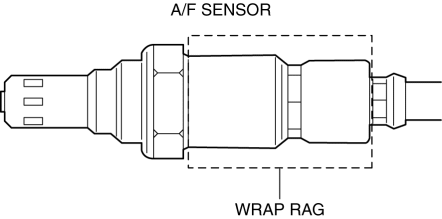
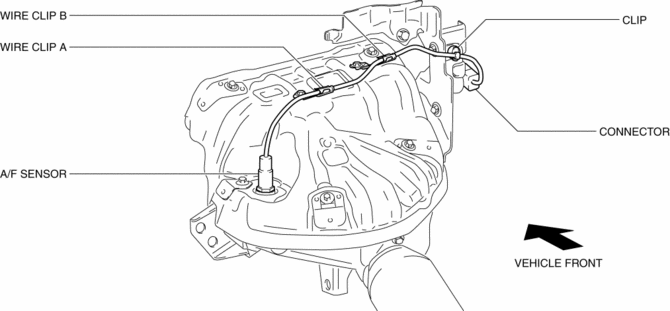
1. Disconnect the negative battery cable..
2. Remove the plug hole plate..
3. Disconnect the A/F sensor connector.
4. Remove the clip from the heat insulator.
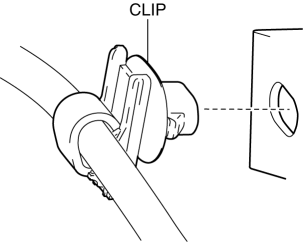
5. Remove the wiring harness from the wire clip A and B..
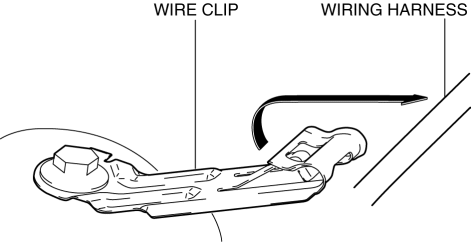
6. Remove the A/F sensor using the SST
.
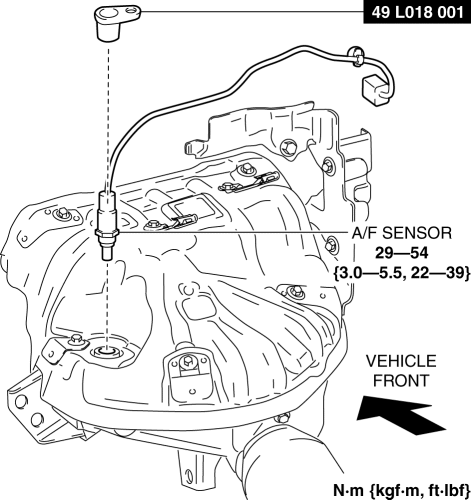
7. Install in the reverse order of removal.
Assembly of Wiring Harness to Wire Clip Note
-
Secure the heat shrinkable tube on the wiring harness to wire clip A.
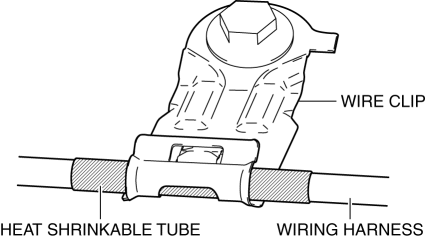
-
Secure the band on the wiring harness so that the band is positioned on both sides of wire clip B.
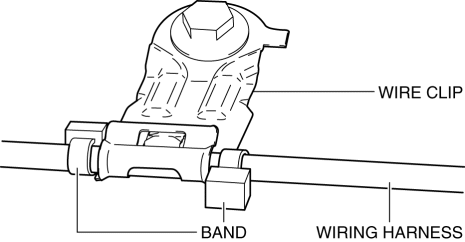
 Air Fuel Ratio (A/F) Sensor Inspection
A/F Sensor Inspection
1. Connect the M-MDS to the DLC?2.
2. Switch the ignition ON (engine on).
3. Warm up the engine to normal operating temperature.
4. Access the following PIDs using the M-M ...
 Air Fuel Ratio (A/F) Sensor
Purpose/Function
Detects the oxygen concentration (all-range air/fuel ratio) in the exhaust
gas as basic information for mainly determining the fuel injection amount.
Detects the oxy ...
Other materials:
Check Fuel Cap Warning Light
Purpose/Function
The check fuel cap warning light is built into the instrument cluster.
If the PCM detects that the fuel cap is open, the light illuminates to warn
the driver that the fuel cap is open.
Construction
Built into the instrument cluster.(See INSTRUMENT CLUS ...
D Pillar Trim Removal/Installation
1. Disconnect the negative battery cable..
2. Remove the following parts:
a. Trunk board.
b. Trunk end trim.
c. Rear scuff plate.
d. Trunk side trim.
3. Take the shaded area shown in the figure, and remove the D-pillar trim in
the direction of the arrow in the order of (1), (2), (3) wh ...
Pressure Control Valve Inspection [Skyactiv G 2.0]
1. Remove the pressure control valve assembly..
CAUTION:
Do not apply a pressure 36 kPa {0.37 kgf/cm2, 5.2 psi} or more. Doing so
will damage the pressure control valve and evaporative hose.
2. Apply a pressure of 36 kPa {0.37 kgf/cm2, 5.2 psi} to port A.
3. Verify that ther ...
