
Mazda CX-5 Service & Repair Manual: Thermostat
Purpose, Function
-
When the engine coolant temperature is low, the thermostat blocks the engine coolant passage between the radiator and engine. As a result, because engine coolant cycles without passing through the radiator, warming is promoted.
Construction
-
The thermostat is installed to the rear part of the cylinder head.
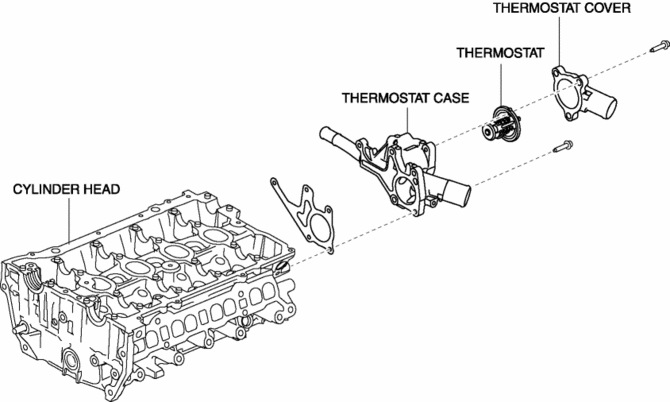
-
The thermostat has the following parts:

Operation
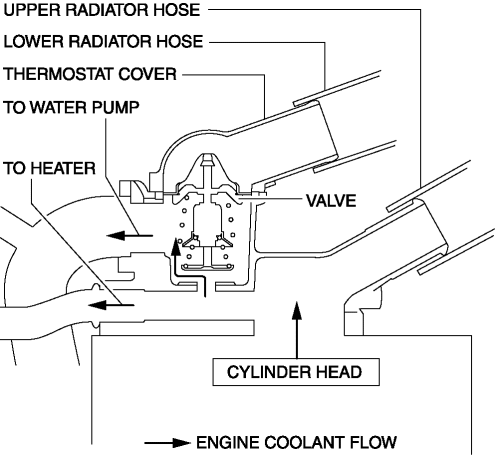
1. When the engine coolant temperature decreases, the thermostat valve closes and engine coolant circulates without passing through the radiator.
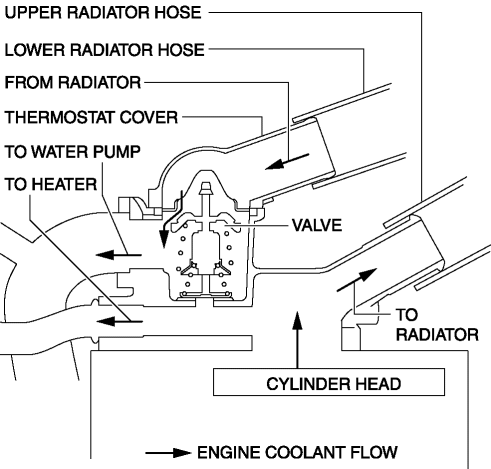
2. When the engine coolant temperature is 80.5—83.5°C, the thermostat valve starts to open and the engine coolant passed through the radiator flows to the engine.
 Thermostat Removal/Installation
WARNING:
Never remove the cooling system cap or loosen the radiator drain plug while
the engine is running, or when the engine and radiator are hot. Scalding engine
coolant and steam may ...
 Emissions
...
Other materials:
Dashboard Under Cover Removal/Installation
1. Detach hooks A in the direction of arrow (1) shown in the figure.
2. Pull the dashboard under cover in the direction of arrow (2) while detaching
pins B.
3. Remove the dashboard under cover in the direction of the arrow (3) shown in
the figure while detaching the guide C.
CAUTION:
...
Neutral Switch Inspection
Continuity Inspection
1. Disconnect the negative battery cable..
2. Remove the neutral switch..
3. Inspect for continuity between neutral switch No.1 terminal A and B.
If not as specified, replace the neutral switch No.1..
Specification
Measured conditio ...
Front Combination Light Disassembly/Assembly
1. Disassemble in the order shown in the figure.
Halogen type
1
Short cord
(See Short Cord Removal Note.)
2
Parking/Front turn light bulb
(See PARKING/FRONT TURN LIGHT BULB REMOVAL/INSTALLATION.)
3
Headlight ...
