
Mazda CX-5 Service & Repair Manual: Front Seat
Purpose, Function
-
The front seats are structured to reduce impact force applied to the head of the occupant in a vehicle collision.
-
8WAY or 6WAY power seats have been adopted on the driver's seat. (with power seat system).
-
A seat warmer system has been adopted on the front seat backs and front seat cushion. (With seat warmer system).
Construction
-
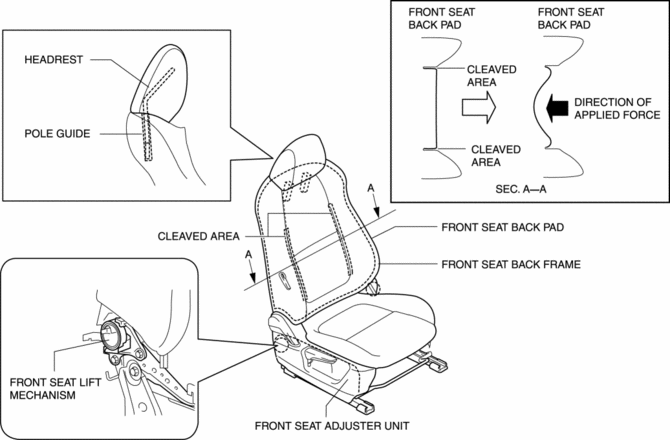
The front seats reduce impact force applied to the head of the occupant in a vehicle collision by improving the rigidity of the pole guides and setting the headrest so that it tilts to the vehicle front.
-
The front seat adjuster unit has improved rigidity by locating the front seat lift mechanism to the area around the connection part on both sides of the front seat back and the front seat cushion, and the backward lean of the front seat back when the occupant's body is pushed backward in a vehicle collision is controlled.
-
If the occupant’s body is pushed backward in a vehicle collision, the front seat back pad separates from the cleaved area and only the center part of the pad is pressed in rearward.
-
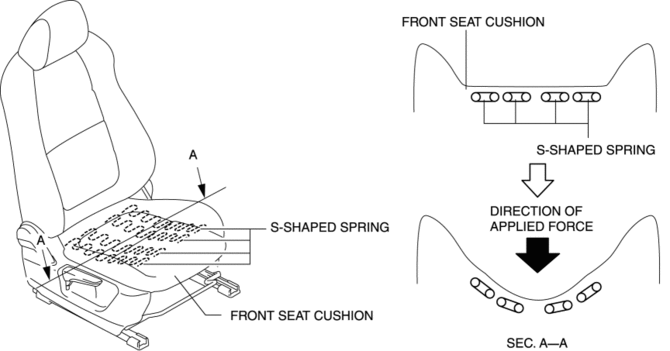
The front seat cushion is built into the S-shaped springs to absorb the impact when the occupant's body is pushed backward.
Operation
Operation (deployment) during a collision
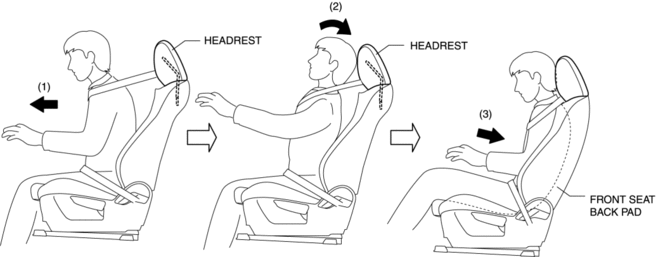
1. During a collision, the occupant moves to the vehicle front, is restrained, and the head and body of the occupant are returned back to the front seat side in reaction to that.
2. When the head and body of the occupant are returned back, the front seat absorbs the return of the head by the headrest and pole guides to reduce impact force applied to the head of the occupant.
3. When the body of the occupant is returned back to the front seat back after absorbing the return of the head by the head restraint and pole guides, the front seat back pad separates from the cleaved area and only the center part of the pad is pressed in rearward.
Fail-safe
-
Function not equipped.
 Seats
Seats
...
 Front Seat Adjuster Unit Removal/Installation
WARNING:
Handling a side air bag improperly can accidentally operate (deploy) the
air bag, which may seriously injure you. Read the service warnings/cautions
in the Workshop Manual befor ...
Other materials:
Cooling Fan Component
Purpose, Function
The cooling fan rotates according to vehicle conditions and enhances the
cooling efficiency of the radiator.
Structural View
Operation
For the operation, refer to CONTROL SYSTEM..
Fail-safe
Function not equipped.
...
Parking/Front Turn Light Bulb Removal/Installation
Halogen Type
1. Disconnect the negative battery cable..
2. Rotate the socket in the direction of the arrow (1) shown in the figure and
remove it from the front combination light in the direction of the arrow (2) shown
in the figure.
3. Remove the parking/front turn light bulb.
4. ...
Spark Plug [Skyactiv G 2.0]
Purpose, Function
The spark plug generates spark, ignition of the air-fuel mixture occurs,
and combustion of the air-fuel mixture is triggered.
Construction
The spark plug is installed to the cylinder head.
Iridium on the center electrode and platinum on the ...
