
Mazda CX-5 Service & Repair Manual: Engine Coolant Replacement
WARNING:
-
Never remove the cooling system cap or loosen the radiator drain plug while the engine is running, or when the engine and radiator are hot. Scalding engine coolant and steam may shoot out and cause serious injury. It may also damage the engine and cooling system.
-
Turn off the engine and wait until it is cool. Even then, be very careful when removing the cap. Wrap a thick cloth around it and slowly turn it counterclockwise to the first stop. Step back while the pressure escapes.
-
When you are sure all the pressure is gone, press down on the cap using the cloth, turn it, and remove it.
CAUTION:
-
Use engine coolant at a concentration that meets the environmental conditions in which the vehicle is driven, otherwise engine damage could occur.
-
The engine has aluminum parts and must be protected by an ethylene-glycol-based coolant to prevent corrosion and freezing.
-
Do not use coolants containing Alcohol, Methanol, Borate or Silicate. These coolants could damage the cooling system.
-
Use only soft (demineralized) water in the coolant mixture. Water that contains minerals will cut down on the coolant's effectiveness.
-
Engine coolant damages paint. If engine coolant does get on a painted surface, rinse it off quickly.
NOTE:
-
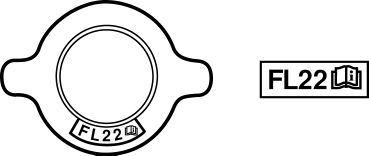
If the “FL22” mark is shown on or near the cooling system cap, use Mazda Genuine FL22 engine coolant.
-
FL22 type engine coolant is shipped as a diluted solution. Use the solution as is when replacing coolant.
-
Engine coolant capacity [Without oil cooler] (approx. quantity)
-
MTX: 7.4 L {7.8 US qt, 6.5 lmp qt}
-
ATX: 7.6 L {8.0 US qt, 6.7 Imp qt}
-
Engine coolant capacity [With oil cooler] (approx. quantity)
-
MTX: 7.5 L {7.9 US qt, 6.6 Imp qt}
-
ATX: 7.8 L {8.2 US qt, 6.9 Imp qt}
1. Remove the cooling system cap.
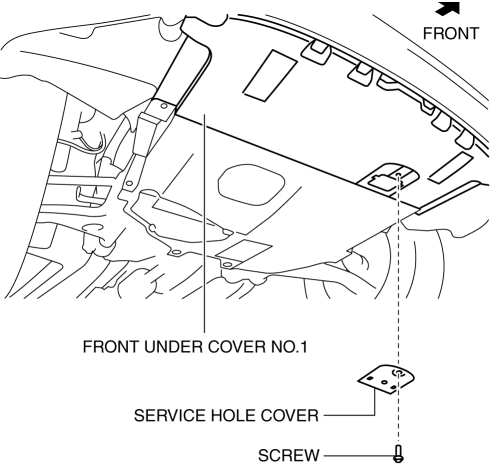
2. Remove the service hole cover (installed to front under cover No.1) used to drain the engine coolant.
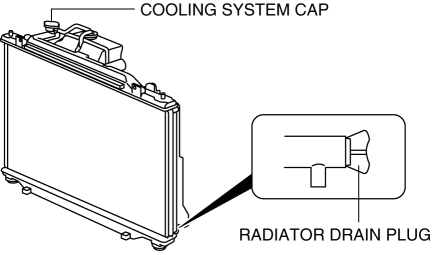
3. Loosen the radiator drain plug and drain the engine coolant into a container.
4. Flush the cooling system with water until all traces of color are gone.
5. Let the system drain completely.
6. Tighten the radiator drain plug.
7. Referring to the following chart, select the correct volume percentage of the water and engine coolant. Antifreeze solution mixture percentage (Except FL22 type engine coolant)
|
Engine coolant protection |
Volume percentage (%) |
Gravity at 20 °C {68 °F} |
||
|
Water |
Coolant |
|||
|
Above -16 °C {3 °F} |
65 |
35 |
1.057 |
|
|
Above -26 °C {-15 °F} |
55 |
45 |
1.072 |
|
|
Above -40 °C {-40 °F} |
45 |
55 |
1.086 |
|
8. Refill the engine coolant from the radiator filler neck until it is close to the top of the radiator filler neck.
9. Refill the engine coolant into the coolant reserve tank up to the F mark on the tank.
10. Install the cooling system cap.
CAUTION:
-
If the high engine coolant temperature warning light flashes, stop the engine to lower the engine coolant temperature and prevent overheating. Then, verify the malfunctioning part and repair or replace it.
11. Start the engine and warm up the engine by idling.
12. After the engine warms up, perform the following steps. At this time, be careful of the engine coolant temperature to prevent overheating.
NOTE:
-
If the accelerator pedal is depressed continuously for a specified time, the engine speed may decrease to the idle speed. This is due to the fuel cut control operation, which prevents overheating, and it does not indicate a malfunction.
a. Run the engine at 2,500 rpm
for 5 min
.
b. Maintain the engine speed at 3,000 rpm
for 5 s, and then idle
.
c. Repeat steps (1), (2) several times.
13. Stop the engine, and inspect the engine coolant level after the engine coolant temperature decreases. If it is low, repeat steps 8—12.
14. Inspect for engine coolant leakage..
15. Install the service hole cover.
 Engine Coolant Protection Inspection
1. Measure the engine coolant temperature and specific gravity using a thermometer
and a hydrometer.
CAUTION:
Use engine coolant at a concentration that meets the environmental conditions ...
 Engine Coolant Temperature (ECT) Sensor Inspection
Resistance Inspection
WARNING:
When the engine is hot, it can badly burn. Turn off the engine and wait until
it is cool before removing the ECT sensor.
ECT Sensor No.1
1. Remove the ...
Other materials:
Returnless Fuel System
Purpose, Outline
Fuel evaporation in the fuel tank is reduced by adjusting the fuel amount
(fuel pressure) ejected from the fuel pump and preventing fuel warmed in the
engine compartment from returning.
System Diagram
2WD
AWD
Structure
The returnless fuel system ...
Audio Unit Removal/Installation
Removal
1. Disconnect the negative battery cable.
2. Remove the decoration panel..
3. Remove the bolt.
4. Remove the screws.
NOTE:
When removing the audio unit, the audio unit could interfere with the climate
control unit and scratch the climate control unit. Perform the serv ...
Cowl Upper Plate Installation [Panel Replacement]
Symbol Mark
Installation Procedure
1. When installing new parts, measure and adjust the body as necessary to conform
with standard dimensions.
2. Drill holes for the plug welding before installing the new parts.
3. After temporarily installing new parts, make sure the related parts fit p ...
