
Mazda CX-5 Service & Repair Manual: Starter Interlock Switch [Skyactiv G 2.0]
Purpose, Function
-
The starter interlock switch mechanism prevents vehicle surge when the engine is started, enhancing safety. The engine cannot be started unless the clutch is depressed.
Construction
-
The mechanism is provided with a starter interlock switch on the circuit under the START STOP UNIT and thePCM.
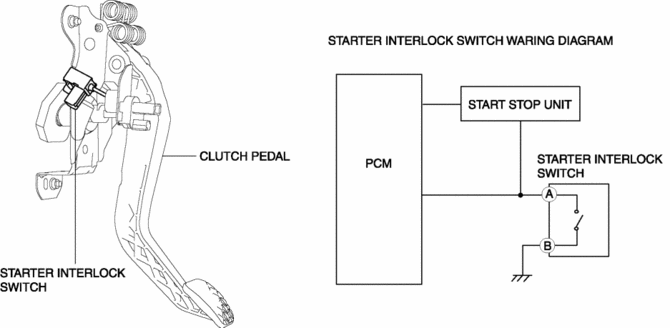
Operation
-
Depressing the clutch pedal presses the starter interlock switch rod. At this time, the starter interlock switch is on, and the power circuit to starter closes. Accordingly, the starter operates only when the clutch is depressed and the engine can be started.
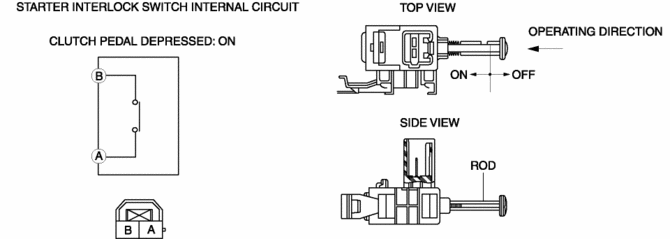
Fail-safe
-
Function not equipped.
 Starter Interlock Switch Removal/Installation [C66 M R]
1. Disconnect the negative battery cable..
2. Disconnect the starter interlock switch connector.
3. Remove the starter interlock using the following procedure:
a. Detach hook A in the direction ...
 Synchronizer Mechanism [C66 M R]
Purpose, Function
For smooth gear changes, the synchronizer mechanism synchronizes the rotation
of the engaging area and engages gears.
Construction
Detent ball-type synchronizer ...
Other materials:
Brake/Clutch Fluid
Inspecting Brake/Clutch Fluid Level
The brakes and clutch draw fluid from the same reservoir.
Inspect the fluid level in the reservoir regularly. It should be kept at MAX.
The level normally drops with accumulated distance, a condition associated with
wear of brake and clutch linings. If it is ...
Flywheel Inspection [C66 M R]
1. Remove the flywheel..
2. Perform the following procedures to inspect the flywheel.
If there is any malfunction or it exceeds the maximum specification, replace
the flywheel..
a. Inspect the surface that contacts the clutch disc for scratches, nicks, and
discoloration.
...
Transfer Removal/Installation [Fw6 Ax EL]
CAUTION:
Performing the following procedures without first removing the front ABS
wheel-speed sensor may possibly cause an open circuit in the harness if it is
pulled by mistake. Before performing the following procedures, disconnect the
front ABS wheel-speed sensor (axle side) and ...
