
Mazda CX-5 Service & Repair Manual: Rear Window Glass Removal
1. Disconnect the negative battery cable..
2. Remove the following parts:
a. Liftgate upper trim.
b. Liftgate side trim.
c. Liftgate recess.
d. Liftgate lower trim.
e. Rear spoiler.
f. Rear wiper arm and blade.
g. Rear wiper motor.
3. Using a screwdriver wrapped in protective tape, pull the antenna feeder No.3 connector in the direction of the arrow (2) shown in the figure while pressing glass antenna terminal in the direction of the arrow (1) shown in the figure, and disengage the glass antenna terminal from the antenna feeder No.3 connector. (with SIRIUS satellite radio system)
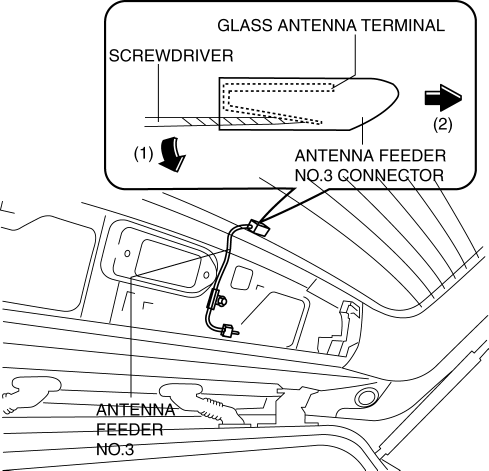
4. Disconnect the antenna feeder No.3 connector. (with SIRIUS satellite radio system)
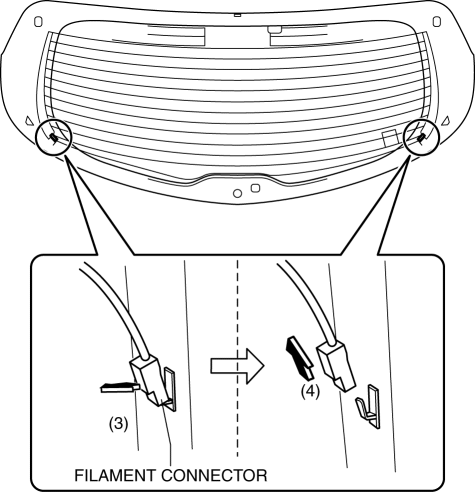
5. Disconnect the filament connectors in the direction of the arrow in the order of (3), (4) shown in the figure.
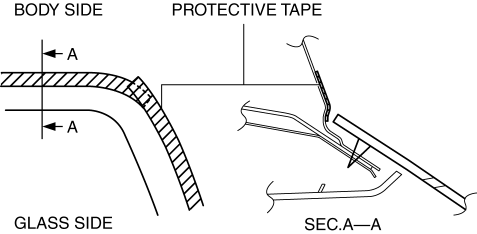
6. Apply protective tape along the edge of the body.
NOTE:
-
Overlap and adhere the protective tape to the corners to prevent damage.
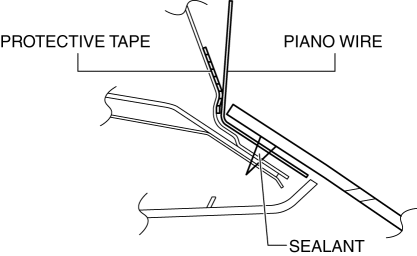
7. Avoiding the pin on the inside of the vehicle, insert piano wire which has been cut to sufficient length.
WARNING:
-
Using piano wire with bare hands can cause injury. Always wear gloves when using piano wire.
NOTE:
-
Before removing the rear window glass from the body, mark the position of the glass by affixing tape to the glass and body panel.
8. Wind each end of piano wire around a bar.
NOTE:
-
Use a long sawing action to spread the work over the whole length of piano wire to prevent it from breaking due to localized heating.
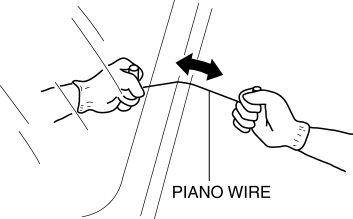
9. Secure one end of piano wire, and while pulling the other end, cut the sealant around the rear window glass.
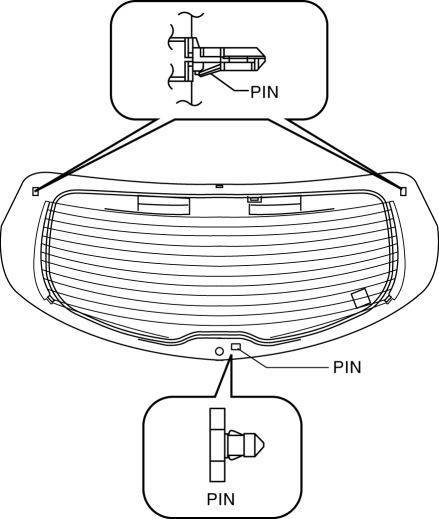
10. Pinch pins from the inside of the vehicle and detach it.
11. Remove the rear window glass.
 Rear Window Glass Installation
WARNING:
Using a utility knife with bare hands can cause injury. Always wear gloves
when using a utility knife.
CAUTION:
Proper installation of the glass may be difficult if s ...
 Windshield Installation
WARNING:
Using a utility knife with bare hands can cause injury. Always wear gloves
when using a utility knife.
CAUTION:
If a door is opened or closed when all the window glas ...
Other materials:
Front Accessory Socket Removal/Installation
1. Disconnect the negative battery cable..
2. Remove the front console..
3. Insert a tape-wrapped flathead screwdriver into the gap between the cap tab
and socket.
4. Move the flathead screwdriver in the direction of the arrow (1) shown in the
figure, press the front accessory socket i ...
Front Body Control Module (Fbcm) Configuration (Using As Built Data)
NOTE:
If the configuration is performed using As-Built data, the set value of the
personalization function is reset to the initial value (condition when shipped
from factory). Verify the set value with the customer and perform the personalization
function setting after performing th ...
Traction Control System (TCS)
The Traction Control System (TCS) enhances traction and safety by controlling
engine torque and braking.
When the TCS detects driving wheel slippage, it lowers engine torque and operates
the brakes to prevent loss of traction.
This means that on a slick surface, the engine adjusts automaticall ...
