
Mazda CX-5 Service & Repair Manual: Oil Pump [Fw6 A EL, Fw6 Ax EL]
Purpose/Function
-
The oil pump generates hydraulic pressure in the oil line of the automatic transaxle together with supplying lubrication to powertrain related parts.
Construction
-
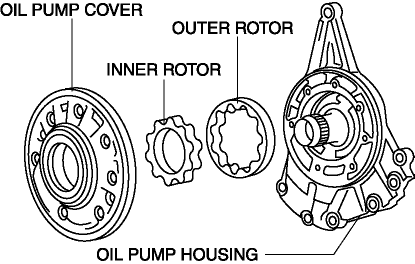
The oil pump has adopted a gear type with built-in outer and inner rotors.
-
The inner rotor engages with the torque converter and rotates in conjunction with the rotation of the torque converter.
Operation
-
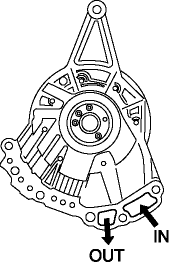
When the inner rotor in the oil pump rotates, vacuum is generated in the outer rotor. As a result, ATF in the oil pan is suctioned to the oil pump. Further rotation of the inner rotor causes the inner rotor blades to push the ATF and discharge it from the oil pump.
-
The ATF discharge flow amount increases or decreases in proportion to the rotation speed of the inner rotor.
 Oil Pump Removal/Installation
WARNING:
Hot engines and engine oil can cause severe burns. Turn off the engine and
wait until it and the engine oil have cooled.
A vehicle that is lifted but not securely supported ...
 Oil Pump
Outline
The oil pump has a mechanism for feedback control of oil pressure. As a result,
an oil pressure increase of more than the set pressure is suppressed and oil
pump drive resistance ...
Other materials:
Light Switch Inspection
Light Switch
1. Disconnect the negative battery cable..
2. Remove the column cover..
3. Remove the light switch..
4. Verify that the continuity between the light switch terminals is as indicated
in the table.
Vehicles without auto light system
Vehicles with auto light system
...
St 001/12 Special Service Tool Shipment January 2013
APPLICABLE MODEL(S)/VINS
2014 Mazda6
2014 CX-5
DESCRIPTION/PRICING
In support of the new 2014 Mazda6 and the 2014 CX-5, Mazda will ship to all dealers
one (1) new Special Service Tool (SST). The SST will be shipped automatically by
Mazda’s tool vendor, SPX during January 2013.
The followi ...
Fuel Gauge Sender Unit Inspection [2 Wd]
NOTE:
For the fuel gauge sender unit removal/installation, refer to the fuel pump
removal/installation because the fuel gauge sender unit is integrated with the
fuel pump..
1. Verify that the resistance at fuel gauge sender unit terminals D and C is
as indicated in the table ac ...
