
Mazda CX-5 Owners Manual: Limitations to SRS Air Bag
In severe collisions such as those described previously in “SRS Air Bag Deployment Criteria”, the applicable SRS air bag equipment will deploy. However, in some accidents, the equipment may not deploy depending on the type of collision and its severity.
Limitations to front/near front collision detection:
The following illustrations are examples of front/near front collisions that may not be detected as severe enough to deploy the SRS air bag equipment.
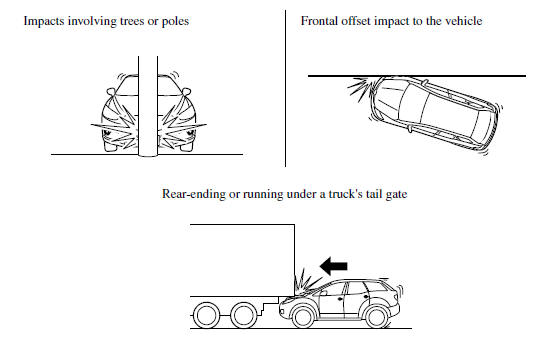
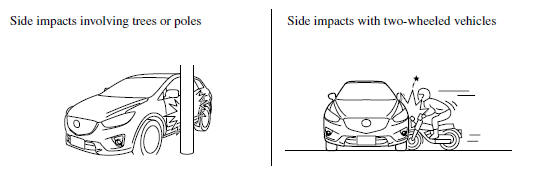
Limitations to side collision detection:
The following illustrations are examples of side collisions that may not be detected as severe enough to deploy the SRS air bag equipment.
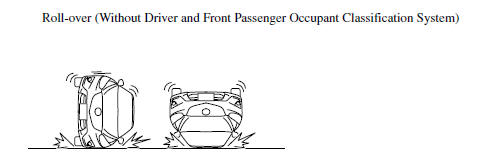
(With Driver and Front Passenger Occupant Classification System) Limitations
to roll-over detection:
The following illustration is an example of an accident that may not be detected as a rollover accident. Therefore, the front seat belt pretensioners and curtain air bags may not deploy.

 SRS Air Bag Deployment Criteria
This chart indicates the applicable SRS equipment that will deploy depending
on the type of collision.
(The illustrations are the representative cases of collisions.)
X: The SRS air bag equipmen ...
 Driver and Front Passenger Occupant Classification System
First, please read “Supplemental Restraint System (SRS) Precautions” carefully.
Driver Seat Slide Position Sensor
Your vehicle is equipped with a driver seat slide position sensor as a par ...
Other materials:
Cargo Compartment Light Inspection
1. Disconnect the negative battery cable..
2. Remove the cargo compartment light..
3. Verify that the continuity between the cargo compartment light terminals is
as indicated in the table.
If not as indicated in the table, replace the cargo compartment light..
...
Active Command Modes Inspection [Blind Spot Monitoring (Bsm)]
1. Connect the M-MDS to the DLC-2.
2. After the vehicle is identified, select the following items from the initialization
screen of the M-MDS.
a. Select “DataLogger”.
b. Select “Modules”.
c. Select “BSML” or “BSMR”.
3. Select the simulation items from the PID table.
4. ...
Cooling System Service Warnings
WARNING:
Never remove the cooling system cap or loosen the radiator drain plug while
the engine is running, or when the engine and radiator are hot. Scalding engine
coolant and steam may shoot out and cause serious injury. It may also damage
the engine and cooling system.
Tu ...
