
Mazda CX-5 Service & Repair Manual: Lights On Reminder Warning Alarm
Purpose
-
The lights-on reminder warning alarm notifies the driver that the TNS and headlights are not turned off.
Function
-
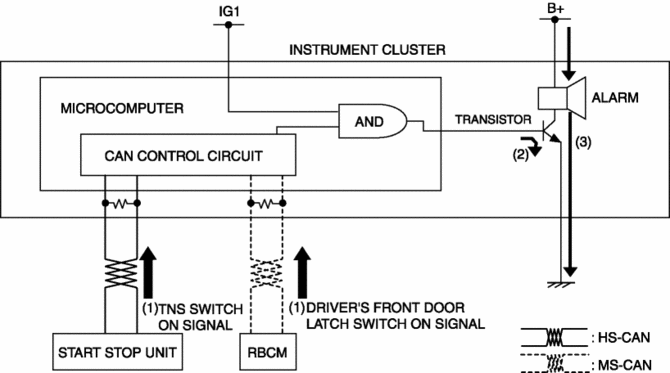
The instrument cluster receives the following vehicle condition signals via the CAN signal from the start stop unit and rear body control module (RBCM).
-
TNS switch ON signal from start stop unit (TNS and headlights illuminate)
-
Driver's front door latch switch ON signal from rear body control module (RBCM)
-
If the ignition is switched to OFF or ACC when all the above vehicle condition signals are received, the instrument cluster operates the lights-on reminder alarm.
-
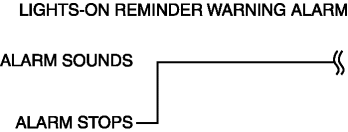
The lights-on reminder warning alarm sound pattern is as shown in the figure.
Construction
-
The lights-on reminder warning alarm sounds using the buzzer built into the instrument cluster.
Operation
1. The instrument cluster receives (1) the TNS switch ON signal from the start stop unit and driver's front door latch switch ON signal from the rear body control module (RBCM).
2. When the ignition is switched to OFF or ACC while each signal is received, the instrument cluster turns on (2) the transistor.
3. When the transistor turns on, the ground circuit of the alarm is established and the alarm sounds (3).
Fail-safe
-
Function not equipped.
 Lights On Indicator Light
Purpose
Notifies the user that the TNS or the headlights (LO) are on.
Function
Illuminates when the illumination conditions for the TNS, headlights (LO),
or parking lights are m ...
 Low Engine Coolant Temperature Indicator Light (Blue)/High Engine Coolant Temperature
Warning Light (Red)
Low Engine Coolant Temperature Indicator Light (Blue)/High Engine Coolant Temperature
Warning Light (Red)
Purpose
Low engine coolant temperature indicator light (blue)
The low engine coolant temperature indicator light (blue) notifies the driver
that the engine coolant temperature is low and va ...
Other materials:
Shift Lock System Inspection
Shift-Lock System Inspection
1. Switch the ignition ON (engine off).
2. Shift the selector lever to the P position.
3. Verify that the selector lever cannot be shifted from P to R position when
the brake pedal is released.
If it can be verified, go to the next step.
If not as ...
Tire Pressure Monitoring System Warning Light
Purpose, Function
The tire pressure monitoring system warning light notifies the driver that
it was determined that a tire pressure has decreased below the specified value
based on the initialization.
The tire pressure monitoring system warning light notifies the driver that
...
Engine Coolant Temperature (ECT) Sensor Removal/Installation
WARNING:
When the engine is hot, it can badly burn. Turn off the engine and wait until
it is cool before removing the ECT sensor.
ECT Sensor No.1
1. Disconnect the negative battery cable..
2. Remove the plug hole plate..
3. Drain the engine coolant..
4. Pull out the evaporati ...
