
Mazda CX-5 Service & Repair Manual: Headlight Leveling Actuator
Purpose, Function
-
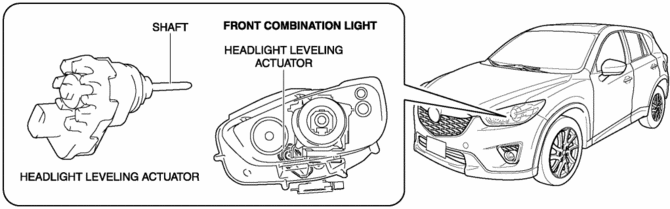
The headlight leveling actuator drives the motor based on the target optical axis voltage, which is input from the AFS control module, to change the optical axis of the headlights.
Construction
-
Built into the front combination lights.
-
Consists of a motor which expands/retracts the shaft, a shaft, and a microcomputer which calculates the shaft expansion/contraction amount.
Operation
1. When the ignition is switched on (engine on or off), the auto leveling sensor inputs a vehicle height signal to the AFS control module.
2. When the headlights (LO) turn on, the AFS control module calculates the amount of change in vehicle height * based on the vehicle height signal.
3. If the operation conditions are met, the AFS control module calculates a target optical axis based on the calculated change in vehicle height *. For details on the operation conditions, refer to the headlight auto leveling system..
4. The AFS control module outputs the calculated target optical axis signal to the headlight leveling actuator.
5. The headlight leveling actuator drives the motor based on the input target optical axis.
6. When the motor is driven, the shaft moves back and forth and the reflector shifts to move the optical axis.
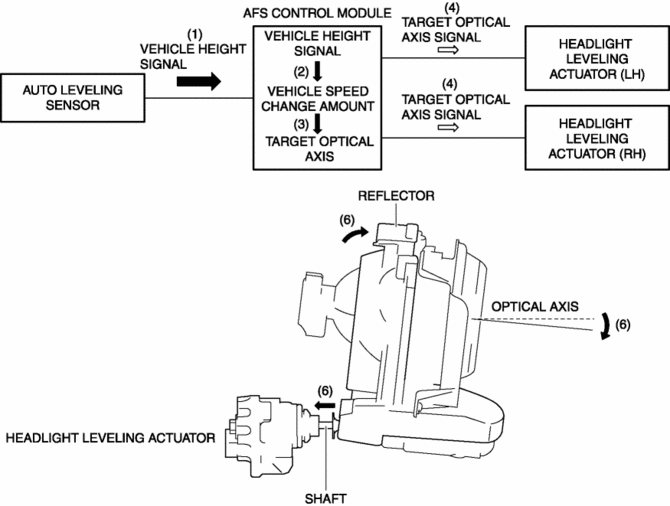
* The amount of change in vehicle height is the calculated 1 s average value of the detected vehicle body angle which the AFS control module detects every 0.1 s.
Fail-safe
-
Function not equipped.
 Headlight High Beam Indicator Light
Purpose
Notifies the user that the headlights (HI) are illuminated.
Function
Illuminates when the headlight (HI) or parking illumination conditions are
met.
Construction
...
 High Mount Brake Light
Purpose
The high-mount brake light signals vehicles to the rear that the vehicle
is stopped.
Function
The high-mount brake light illuminates in conjunction with the operation
...
Other materials:
Door Trim
Purpose/Function
The front and rear door trims are equipped with shock absorbing pads for
impulse force relief during a collision.
Construction
Shock absorbing pads are installed inside the front and rear door trims.
Shock absorbing pads absorb the impulse force during ...
Afs (Adaptive Front Lighting System) Control Module
Purpose
The AFS control module calculates the target optical axis based on the vehicle
height signal and outputs the target optical axis signal to the headlight leveling
actuator.
Function
The AFS control module performs control of the AFS and headlight auto leveling.
...
Front Brake (Disc) Removal/Installation
1. Remove in the order indicated in the table.
2. Install in the reverse order of removal.
3. After installation, add brake fluid, bleed the air, and inspect for fluid
leakage..
4. Depress the brake pedal a few times, rotate the wheel by hand, and verify
that the brake does not drag.
...
