
Mazda CX-5 Service & Repair Manual: Front Shock Absorber Disposal
WARNING:
-
Whenever drilling into a front shock absorber, wear protective eye wear. The gas in the front shock absorber is pressurized, and could spray metal chips into the eyes and face when drilling.
1. Place the shock absorber on a level surface or with the piston pointing downwards.
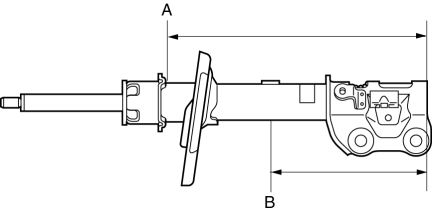
2. Drill a 2—3 mm {0.08—0.11 in}
hole at point A shown in the figure so the gas can escape.
-
Point A: 340 mm {13.4 in}
3. Drill a 2—3 mm {0.08—0.11 in}
hole at the point B shown in the figure to drain the oil.
-
Point B: 145 mm {5.71 in}
4. Turn the hole made in Step 3 downwards and drain the oil by pumping the piston rod up and down several times.
5. Cut off the bottom end of the front shock absorber.
6. Dispose of waste oil according to local waste disposal laws.
 Front Shock Absorber And Coil Spring Removal/Installation
CAUTION:
Performing the following procedures without first removing the front ABS
wheel-speed sensor may possibly cause an open circuit in the wiring harness
if it is pulled by mistake ...
 Front Shock Absorber Inspection
1. Remove the front shock absorber..
2. Inspect for damage and oil leakage.
3. Compress and extend the shock absorber piston rod at least three times
at a steady rate. From the fourth compressio ...
Other materials:
Auxiliary Jack/Usb Port Removal/Installation
1. Disconnect the negative battery cable..
2. Remove the upper console..
3. While pressing the auxiliary jack/USB port. tabs in the direction of the arrows
(1) shown in the figure, press the auxiliary jack/USB port. in the direction of
the arrow (2) to detach the auxiliary jack/USB port. tab ...
Turn And Hazard Indicator Alarm
Purpose
The turn and hazard indicator alarm notifies the driver that a turn light
or the hazard warning lights are flashing.
Function
When the instrument cluster receives the turn signal/hazard warning indicator
light illumination request signal sent from the front body con ...
Caliper (Front) Disassembly/Assembly
1. Disassemble in the order indicated in the table.
1
Bleeder cap
2
Bleeder screw
3
Piston
(See Piston Disassembly Note.)
4
Dust seal
5
Piston seal
...
