
Mazda CX-5 Service & Repair Manual: Charcoal Canister Inspection
U.S.A. And CANADA
Leakage inspection
1. Perform the following procedures:
-
Do not operate CV solenoid valve.
-
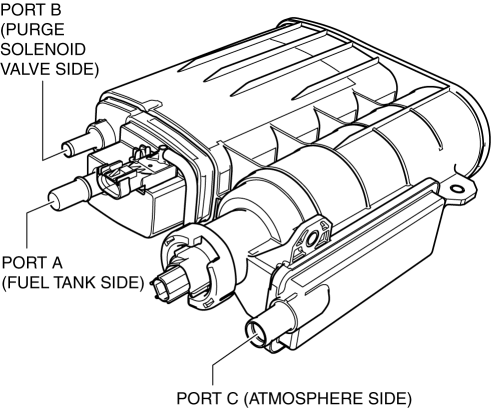
Assemble the hose used for inspection to port A.
-
Cover ports B and C with the caps.
CAUTION:
-
Do not apply a pressure 20 kPa {150 mmHg, 5.91 inHg} or more to the charcoal canister for 1 min. or more. Doing so will damage the charcoal canister.
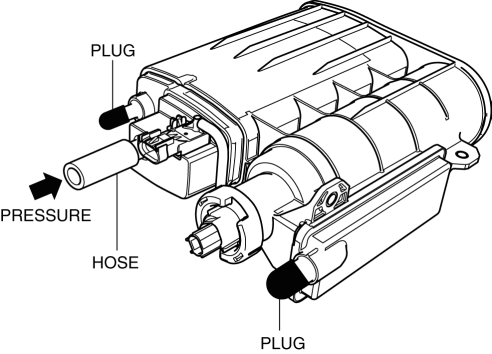
2. Apply pressure (19.6 kPa {147 mmHg, 5.79 inHg}
) through the hose, and verify that air does not leak from the charcoal canister.
-
If there is airflow, replace the charcoal canister..
-
If there is no airflow, perform the following “Airflow Inspection”..
Airflow inspection
1. Perform the following procedure to verify the charcoal canister airflow.
-
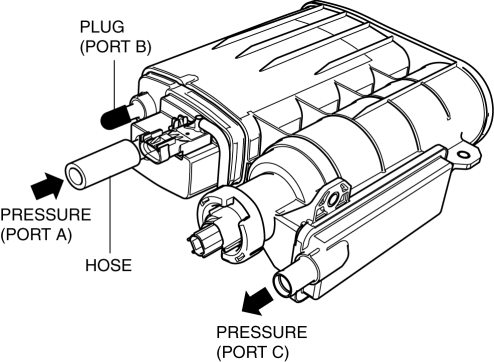
Between port A and port C
-
Plug the port B.
-
Apply a pressure of 1.8 kPa {14 mmHg, 0.53 inHg}
to port A.
-
Verify that there is airflow from port C.
-
If there is no airflow, replace the charcoal canister..
-
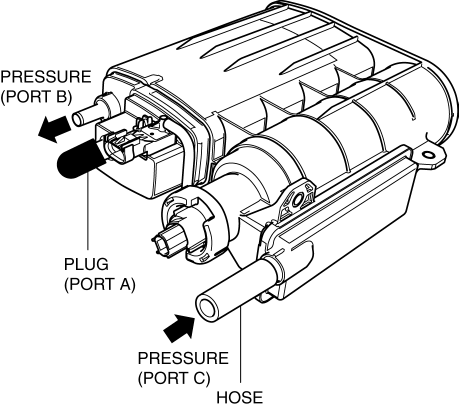
Between port B and port C
-
Plug the port A.
-
Apply a pressure of 2.0 kPa {15 mmHg, 0.59 inHg}
to port C.
-
Verify that there is airflow from port B.
-
If there is no airflow, replace the charcoal canister..
Except U.S.A. And CANADA
Leakage inspection
1. Perform the following procedures:
-
Assemble the hose used for inspection to port A.
-
Cover ports B and C with the caps.
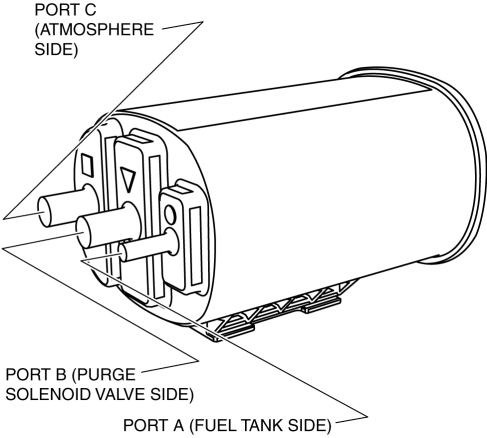
CAUTION:
-
Do not apply a pressure 20 kPa {150 mmHg, 5.91 inHg} or more to the charcoal canister for 1 min. or more. Doing so will damage the charcoal canister.
2. Apply pressure (19.6 kPa {147 mmHg, 5.79 inHg}
) through the hose, and verify that air does not leak from the charcoal canister.
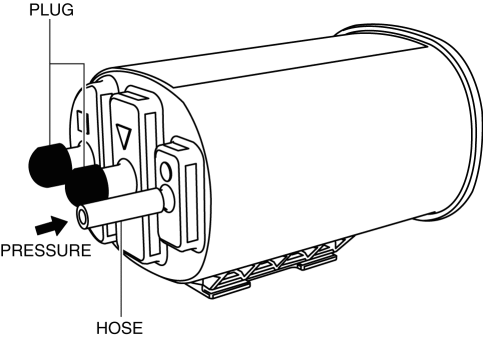
-
If there is airflow, replace the charcoal canister..
-
If there is no airflow, perform the following “Airflow Inspection”..
Airflow inspection
1. Perform the following procedure to verify the charcoal canister airflow.
-
Between port A and port C
-
Plug the port B.
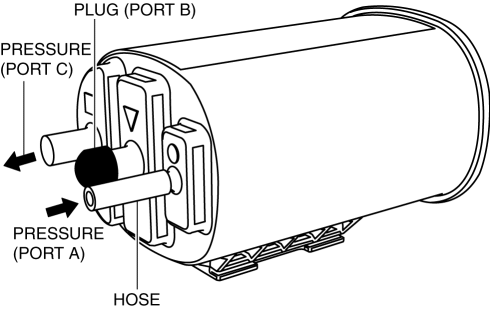
-
Apply a pressure of 0.98 kPa {7.4 mmHg, 0.29 inHg}
to port A.
-
Verify that there is airflow from port C.
-
If there is no airflow, replace the charcoal canister..
-
Between port B and port C
-
Plug the port A.
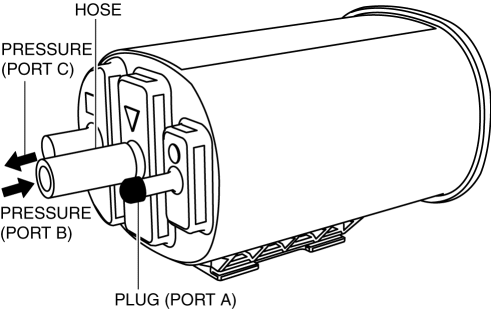
-
Apply a pressure of 0.98 kPa {7.4 mmHg, 0.29 inHg}
to port C.
-
Verify that there is airflow from port B.
-
If there is no airflow, replace the charcoal canister..
 Catch Tank
Purpose, Function
Suppresses pulsation occurring before evaporative gas is inducted into the
intake manifold.
Construction
The catch tank is installed in the engine compartment. ...
 Charcoal Canister Removal/Installation
U.S.A. And CANADA
1. Disconnect the negative battery cable..
2. Remove the floor under cover..
3. Remove in the order indicated in the table.
1
Quick release connect ...
Other materials:
Automatic Transaxle Removal/Installation [Fw6 Ax EL]
CAUTION:
Performing the following procedures without first removing the front ABS
wheel-speed sensor may possibly cause an open circuit in the harness if it is
pulled by mistake. Before performing the following procedures, disconnect the
front ABS wheel-speed sensor (axle side) and ...
Body And Accessories SST
49 L067 001
Reflector
49 L067 002
Tripod
49 L067 003
Plum-bob
49 L067 006
Plum-bob
—
—
...
Catalytic Converter
Purpose, Function
Purifies contaminants in the exhaust gas by utilizing the chemical reactions
of the three-way catalytic converter.
A WU-TWC and a TWC have been adopted.
WU-TWC
The three-way catalyst is integrated with the exhaust manifold.
Because the c ...
