
Mazda CX-5 Service & Repair Manual: Engine Coolant Leakage Inspection
WARNING:
-
Never remove the cooling system cap or loosen the radiator drain plug while the engine is running, or when the engine and radiator are hot. Scalding engine coolant and steam may shoot out and cause serious injury. It may also damage the engine and cooling system.
-
Turn off the engine and wait until it is cool. Even then, be very careful when removing the cap. Wrap a thick cloth around it and slowly turn it counterclockwise to the first stop. Step back while the pressure escapes.
-
When you are sure all the pressure is gone, press down on the cap using the cloth, turn it, and remove it.
1. Inspect the engine coolant level..
2. Remove the cooling system cap.
3. Install the radiator cap tester to the radiator filler neck.
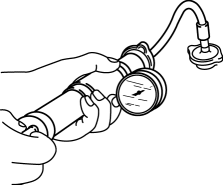
4. Apply pressure using the radiator cap tester.
CAUTION:
-
Applying more than 122.6 kPa {1.250 kgf/cm2, 17.78 psi} can damage the hoses, fittings, and other components, and cause leakage.
-
Engine coolant leakage inspection pressure
-
122.6 kPa {1.250 kgf/cm2, 17.78 psi} [1 min]
5. When pressurizing the cooling system, verify that the pressure is maintained.
-
If the gauge needle drops, it may indicate water leakage. Repair or replace the applicable part.
 Electrical Fan Control
Outline
Through cooling of the radiator and condenser by operation of the cooling
fan according to vehicle conditions, engine reliability and cooling performance
have been improved.
...
 Engine Coolant Level Inspection
WARNING:
Never remove the cooling system cap or loosen the radiator drain plug while
the engine is running, or when the engine and radiator are hot. Scalding engine
coolant and steam may ...
Other materials:
Pre Tensioner Seat Belt [Standard Deployment Control System]
Purpose
The pre-tensioner seat belt retracts and tightens the seat belt webbing to
protect the front passengers during a collision.
Function
The pre-tensioner seat belts operate (deploy) based on the operation signal
from the SAS control module to instantly retract and tigh ...
Sunvisor Removal/Installation
1. Disconnect the negative battery cable. (with vanity mirror illumination).
2. Remove the screw A.
3. Rotate the sunvisor in the direction of the arrow.
4. Unhook and remove the sunvisor.
5. Disconnect the vanity mirror illumination connector. (with vanity mirror illumination)
6. Pr ...
Power Seat Switch Removal/Installation
WARNING:
Handling a side air bag improperly can accidentally operate (deploy) the
air bag, which may seriously injure you. Read the service warnings/cautions
in the Workshop Manual before handling the front seat (side air bag integrated)..
1. Switch the ignition off (LOCK).
2. ...
