
Mazda CX-5 Owners Manual: Washer Fluid
InspectingWasher Fluid Level
WARNING
Use only windshield washer fluid or plain water in the reservoir:
Using radiator antifreeze as washer fluid is dangerous. If sprayed on the windshield, it will dirty the windshield, affect your visibility, and could result in an accident.
Using Washer Fluid Without Anti-freeze Protection in Cold Weather:
Operating your vehicle in temperatures below 4 degrees C (40 degrees F) using washer fluid without anti-freeze protection is dangerous as it could cause impaired windshield vision and result in an accident. In cold weather, always use washer fluid with anti-freeze protection.
NOTE
State or local regulations may restrict the use of volatile organic compounds (VOCs), which are commonly used as anti-freeze agents in washer fluid. A washer fluid with limited VOC content should be used only if it provides adequate freeze resistance for all regions and climates in which the vehicle will be operated.
Inspect fluid level in the washer fluid reservoir; add fluid if necessary.
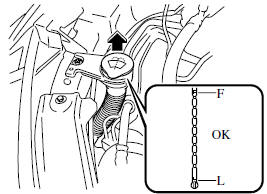
The top of the float should be between F and L.
Use plain water if washer fluid is unavailable.
But use only washer fluid in cold weather to prevent it from freezing.
NOTE
Front and rear washer fluid is supplied from the same reservoir.
 Brake/Clutch Fluid
Inspecting Brake/Clutch Fluid Level
The brakes and clutch draw fluid from the same reservoir.
Inspect the fluid level in the reservoir regularly. It should be kept at MAX.
The level normally drops ...
 Body Lubrication
All moving points of the body, such as door and hood hinges and locks, should
be lubricated each time the engine oil is changed. Use a nonfreezing lubricant on
locks during cold weather.
Make sur ...
Other materials:
Rear ABS Wheel Speed Sensor Removal/Installation
1. Remove the trunk board..
2. Remove the trunk end trim..
3. Remove the rear scuff plate..
4. Remove the trunk side trim..
5. Disconnect the rear ABS wheel-speed sensor connector.
6. Press the rear ABS wheel-speed sensor tabs and press out the sensor toward
the outside of the vehicl ...
Air Cleaner Element Inspection
1. Remove the air cleaner element..
2. Inspect the following items:
Has the replacement interval past?
Is the air cleaner element soiled, damaged, or bent?
Are the air cleaner case and the air cleaner element correctly sealed?
Is the correct air cleaner element inst ...
Front Door Speaker Inspection
1. Disconnect the negative battery cable..
2. Remove the following parts:
a. Inner garnish.
b. Front door trim.
3. Disconnect the front door speaker connector..
4. Verify that the resistance and continuity between the front door speaker terminals
is as indicated in the table.
...
