
Mazda CX-5 Service & Repair Manual: Seat Track Position Sensor [Two Step Deployment Control System]
Purpose
-
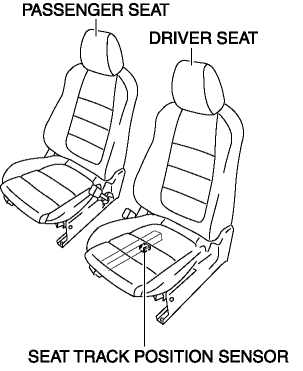
The seat track position sensor detects the front and back positions of the driver seat.
Function
-
The seat track position sensor converts the seat position into an electrical signal and sends it to the SAS control module.
Construction
-
The seat track position sensor consists of a hall element (semi-conductor) and a magnet. The sensor converts the effect of the magnetic flux (produced by the magnet) on the hall element, into an electrical signal.
-
The seat track position sensor installed on the driver-side seat rail.
Operation
-
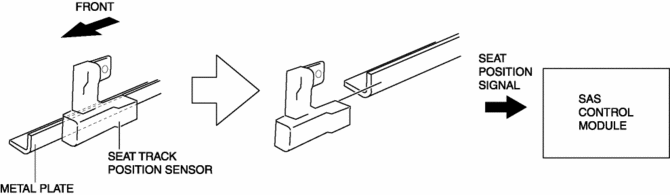
If the driver’s seat is slid forward, the seat track position sensor will separate from the metal plate installed to the seat slider.
-
When this occurs the magnetic flux of the sensor changes and that change is sent as an electrical signal to the SAS control module.
-
The SAS control module receives this signal and determines that the driver’s seat has been moved to a forward position.
Fail-safe
-
Function not equipped.
 Seat Track Position Sensor Removal/Installation [Two Step Deployment Control
System]
Seat Track Position Sensor Removal/Installation [Two Step Deployment Control
System]
1. Switch the ignition to off.
2. Disconnect the negative battery cable and wait for 1min or more..
3. Remove the front driver’s seat..
4. Disconnect the connector from the seat track positio ...
 Seat Weight Sensor Calibration [Two Step Deployment Control System]
CAUTION:
If any of the following work is performed, perform the seat weight sensor
calibration using the M-MDS.
Replacement with a new seat weight sensor
Replacement ...
Other materials:
Brake Fluid Pressure Sensor
Purpose/Function
The brake fluid pressure sensor detects the fluid pressure from the master
cylinder and transmits it to the DSC HU/CM.
Construction
The brake fluid pressure sensor is built into the DSC HU/CM. Therefore if
there is any malfunction of the brake fluid pressur ...
Condenser
Purpose
The condenser cools the high-temperature, highly pressurized refrigerant.
Function
The condenser cools the high-temperature, highly pressurized gaseous refrigerant
compressed by the A/C compressor using the outside air, and changes it to liquid
refrigerant.
Co ...
Antenna Feeder No.3 Inspection
1. Disconnect the negative battery cable..
2. Remove the following parts:
a. Front scuff plate.
b. Rear scuff plate.
c. B-pillar lower trim.
d. Front seat belt adjusting cover.
e. Front seat belt upper anchor installation bolt.
f. B-pillar upper trim.
g. Rear seat cushion.
h. Trunk ...
