
Mazda CX-5 Owners Manual: Parking in an Emergency
Parking in an Emergency
The hazard warning lights should always be used when you stop on or near a roadway in an emergency.
The hazard warning lights warn other drivers that your vehicle is a traffic hazard and that they must take extreme caution when near it.
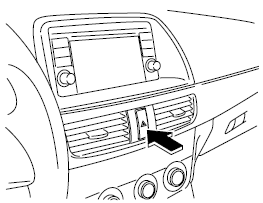
Depress the hazard warning flasher and all the turn signals will flash. The hazard warning indicator lights in the instrument cluster flash simultaneously.
NOTE
• The turn signals do not work when the hazard warning lights are on.
• Check local regulations about the use of hazard warning lights while the vehicle is being towed to verify that it is not in violation of the law.
 If Trouble Arises
Helpful information on what to do if a problem arises with the vehicle. ...
 Flat Tire
...
Other materials:
Abbreviations
AAS
Active Adaptive Shift
ABS
Antilock Brake System
ABDC
After Bottom Dead Center
ACC
Accessories
AFS
Adaptive Front Lighting System
ALC
...
Rear Stabilizer Removal/Installation [2 Wd]
WARNING:
Verify that the rear crossmember is securely supported by a jack. If the
rear crossmember falls off, it can cause serious injury or death, and damage
to the vehicle.
CAUTION:
Performing the following procedures without first removing the rear ABS wheel-spee ...
Solar Radiation Sensor [Full Auto Air Conditioner]
Purpose
The solar radiation sensor detects the sunlight intensity emitted to the
cabin.
Function
The solar radiation sensor converts the detected solar radiation amount to
an electric signal.
Construction
A photodiode (light receiving diode) has been adopted fo ...
