
Mazda CX-5 Owners Manual: Center-Rear Position Seat Belt
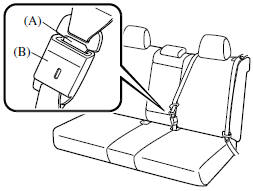
Before using the center-rear lap/shoulder belt make sure tongue (A) and anchor buckle (B) are fastened.
Fastening the Seat Belt
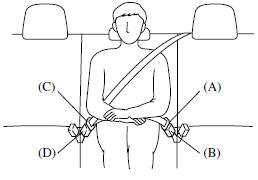
1. Grasp the seat belt tongue (C).
2. Slowly pull out the lap/shoulder belt.
3. Insert the seat belt tongue (C) into the seat belt buckle (D) until you hear a click sound.
WARNING
Fastening the Center-Rear Seat Belt with Only One Buckle: Fastening the center-rear seat belt with only one buckle is dangerous. If only one pair of seat belt tongues and buckles is fastened (either seat belt tongue (C) and seat belt anchor buckle (D) or seat belt tongue (A) and seat belt buckle (B)), then the seat belt cannot provide full protection. In a sudden stop or collision, the user could slide under the belt and suffer serious injuries. Always make sure that both pairs of seat belt tongues and buckles are fastened properly.
 Front Seat Belt Pretensioner and Load Limiting Systems
For optimum protection, the driver and front passenger seat belts are equipped
with pretensioner and load limiting systems. For both these systems to work properly
you must wear the seat belt prop ...
 Seat Belt Extender
If your seat belt is not long enough, even when fully extended, a seat belt extender
may be available to you at no charge from your Authorized Mazda Dealer.
This extender will be only for you and f ...
Other materials:
Steering Gear And Linkage
Purpose/ Function
The rotational movement input from the intermediate shaft is converted to
a linear movement in the horizontal direction of the steering rack by the rack
and pinion mechanism, and then transmitted to the tires and wheels.
Construction
A size and weight-redu ...
Oil Filter
Purpose, Function
Engine oil is filtered by passing engine oil through the oil filter element.
Construction
The oil filter is installed on the right side surface of the cylinder block.
A spin-on type (full-flow type) oil filter has been adopted.
The bypa ...
Generator Control [Skyactiv G 2.0]
Outline
Idling stability has been improved by optimum control of generator voltage
according to engine operation and electrical load conditions.
The PCM determines the engine operation and electrical load conditions based
on the input signals from each control part and controls ...
