
Mazda CX-5 Service & Repair Manual: Accelerator Pedal, Kickdown Switch
Purpose, Function
-
The driver's intentions are transmitted to the PCM via the accelerator pedal.
-
Kickdown switch (ATX) (Applied VIN (assumed): JM3 KE2*E*D# 148107?)
-
If the accelerator pedal is depressed carelessly, kickdown control will be implemented based on the accelerator pedal being determined as fully open, and vehicle shock will occur. A kickdown switch has been adopted so that it can be determined that the accelerator pedal is fully open based on the driver’s intention of depressing the accelerator pedal for kickdown.
Construction
-
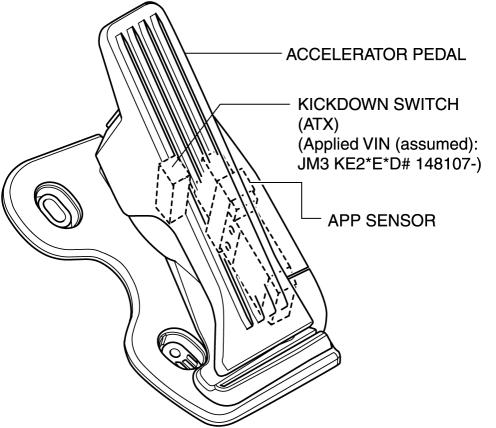
The accelerator pedal has a built-in APP sensor and kickdown switch (ATX).
-
For the APP sensor, refer to CONTROL SYSTEM..
Kickdown Switch (ATX) (Applied VIN (assumed): JM3 KE2*E*D# 148107?)
-
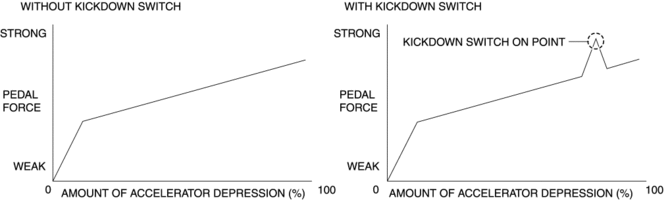
A load can be felt while the accelerator pedal is being depressed and when it is further depressed the kickdown switch turns on.
-
The driver can control the kickdown by knowing the amount of accelerator depression.
-
The kickdown switch is only a measure of the kickdown. An electrical signal is not transmitted by the kickdown switch turning on/off, and vehicle control is not affected.
 Accelerator Pedal Removal/Installation
1. Disconnect the negative battery cable..
2. Remove in the order indicated in the table.
1
APP sensor connector
2
Accelerator pedal
...
 Air Bag Module And Pre Tensioner Seat Belt Deployment Procedures [Standard Deployment
Control System]
Air Bag Module And Pre Tensioner Seat Belt Deployment Procedures [Standard Deployment
Control System]
WARNING:
A live (undeployed) air bag module or pre-tensioner seat belt may accidentally
operate (deploy) when it is disposed of and cause serious injury. Do not dispose
of a live (undepl ...
Other materials:
Instrument Cluster Removal/Installation
CAUTION:
If configuration is not performed when the instrument cluster is replaced
with a new one, the vehicle specification information is not stored in the instrument
cluster and the system will not operate normally.
When performing configuration, it is necessary to read the ...
Seat Belt Warning Light
Purpose
The seat belt warning light warns the driver that a seat belt is not fastened.
Function
The instrument cluster flashes/illuminates the seat belt warning light based
on the following CAN signals:
Vehicle speed signal sent from PCM
Driver/passenge ...
Side Garnish Removal
Front
1. Insert a tape-wrapped flathead screwdriver in the position shown in the figure,
move it in the direction of the arrow (1) to remove the clip A.
2. Slide the side garnish in the direction of the arrow (2) shown in the figure
and remove clips B from side garnish.
3. Remove clips ...
