
Mazda CX-5 Service & Repair Manual: Panel Light
Purpose
-
The panel light adjusts the instrument cluster and steering switch illumination brightness.
Function
-
The instrument cluster adjusts the brightness of the following illumination lights when a TNS illumination signal sent via CAN transmission from the front body control module (FBCM) is received.
-
Instrument cluster
-
Climate control unit
-
Steering switch
-
Cluster switch
-
Hazard warning switch
-
Selector illumination
-
Audio unit
-
Clock (with manual A/C)
-
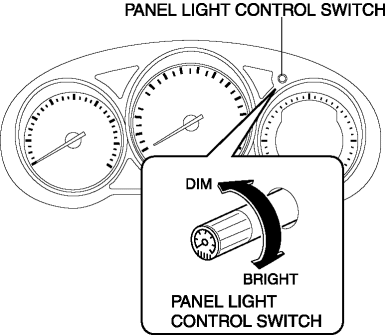
The instrument cluster changes the brightness of the illumination lights according to the rotation signal of the panel light control switch.
Construction
-
The panel light control switch is set in the instrument cluster.
Operation
-
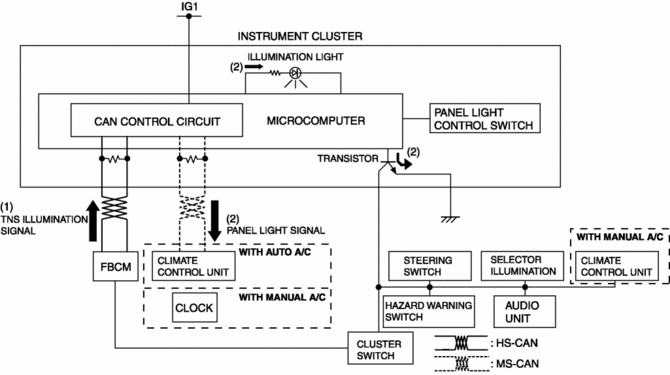
When the ignition is switched ON (engine off or on), the instrument cluster receives (1) the TNS illumination signal from the front body control module (FBCM).
-
The instrument cluster performs the following controls when it receives the TNS illumination signal.
-
Changes the brightness of the instrument panel illumination.
-
Outputs a panel light signal via CAN signal to the climate control unit (with auto A/C)/clock (with manual A/C).
-
Turns on the panel light circuit transistor.
-
When the transistor turns on, a ground circuit with the panel light is established and the panel light illuminates.
Panel light control switch operation
-
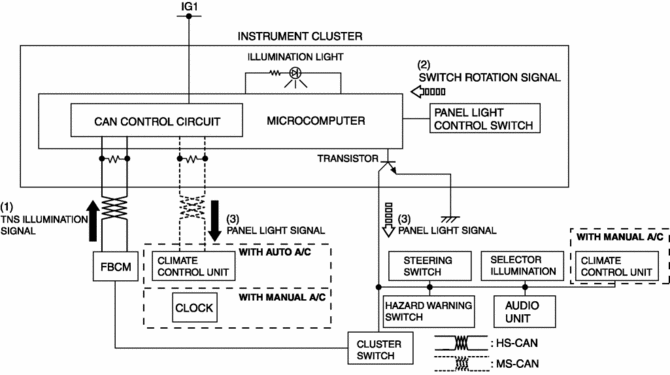
When the ignition is switched ON (engine off or on), the instrument cluster receives (1) the TNS illumination signal from the front body control module (FBCM).
-
The instrument cluster changes the brightness of the panel light according to the rotation angle when it receives a panel light control switch rotation signal while receiving the TNS illumination signal.
-
The instrument cluster outputs a panel light signal to related units.
Fail-safe
-
Function not equipped.
 PID/Data Monitor Inspection [Instrument Cluster]
1. Connect the M-MDS to the DLC-2.
2. After the vehicle is identified, select the following items from the initialization
screen of the M-MDS.
a. Select “DataLogger”.
b. Select “Modulesâ ...
 Gauges
...
Other materials:
Oil Seal (Differential) Replacement [C66 M R]
1. Remove the front under cover No.2..
2. Drain the manual transaxle oil..
3. Disconnect the drive shaft (LH) from the MTX..
4. Disconnect the drive shaft (RH) from the MTX..
5. Remove the oil seal (LH).
6. Remove the oil seal (RH).
7. Using the SSTs and a hammer, tap a new oil s ...
Suspension
49 T034 1A0
Coil spring compressor set
49 T028 3A0
Ball joint puller set
49 G033 102
Handle
49 U034 204
Dust boot installer
49 FT01 389
Pr ...
Master Cylinder Removal/Installation
1. Remove the battery..
2. Remove in the order indicated in the table.
3. Install in the reverse order of removal.
4. After installation, add brake fluid, bleed the air, and inspect for fluid
leakage..
1
Brake fluid level sensor connector
2
...
