
Mazda CX-5 Service & Repair Manual: Electric Variable Valve Timing Motor/Driver Inspection
WARNING:
-
A hot engine can cause severe burns. Turn off the engine and wait until it is cool before servicing.
CAUTION:
-
Do not disassemble the electric variable valve timing motor/driver because it is a precision unit.
-
Do not apply excessive force when rotating the electric variable valve timing motor joint. If it is rotated with excessive force, the electric variable valve timing motor could be damaged.
1. Disconnect the negative battery cable..
2. Remove the plug hole plate..
3. Remove the electric variable valve timing motor/driver..
4. Rotate the electric variable valve timing motor joint to the left and right by your fingers and verify that it rotates smoothly in 15°
increments.
NOTE:
-
Rotate the joint area smoothly using only the tips of your fingers.
-
The electric variable valve timing motor joint moves in 15°
increments, and if the joint is moved 24
times, it rotates one full rotation.
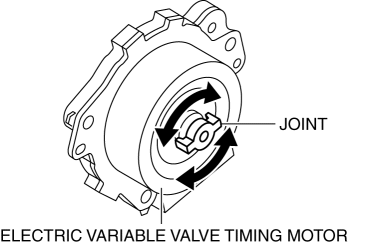
-
If it does not rotate smoothly, replace the electric variable valve timing motor/driver.(See ELECTRIC VARIABLE VALVE TIMING MOTOR/DRIVER REMOVAL/INSTALLATION [SKYACTIV-G 2.0].)
5. Install in the reverse order of removal.
 Electric Variable Valve Timing Actuator, Hydraulic Variable Valve Timing Actuator
Removal/Installation
Electric Variable Valve Timing Actuator, Hydraulic Variable Valve Timing Actuator
Removal/Installation
WARNING:
A hot engine can cause severe burns. Turn off the engine and wait until it
is cool before servicing.
CAUTION:
Do not disassemble the electric variable valve timing ac ...
 Electric Variable Valve Timing Motor/Driver Removal/Installation
WARNING:
A hot engine can cause severe burns. Turn off the engine and wait until it
is cool before servicing.
CAUTION:
Applying excessive force (force of 100 N {10.2 kgf, 22.5 ...
Other materials:
Front Fog Light Removal/Installation
1. Disconnect the negative battery cable..
2. Remove the screws and bolt.
3. Pull up the front under cover No.1 and remove the mudguard screw shown in
the figure.
4. Disconnect the connector.
5. While pressing the clip tab in the direction of the arrow (1) shown in the
figure ...
Liftgate Light
Purpose
The liftgate lights are used to signal the following conditions to vehicles/people
at the rear.
Back-up lights: Signals that the vehicle is backing up.
Taillights: Signals the presence of the vehicle during nighttime.
Function
The back-up ...
Entertainment System
Outline
The following entertainment system has been adopted.
Audio system (with audio system)
Car-navigation system (with car-navigation system)
Park assist system (with park assist system)
Bluetooth system (with Bluetooth system)
...
