
Mazda CX-5 Service & Repair Manual: Efficient Installation Of Body Panels
Checking Preweld Measurements And Watching
-
Align to the standard reference dimensions, based upon the body dimensions illustration, so that new parts are installed in the correct position.

Welding Notes
-
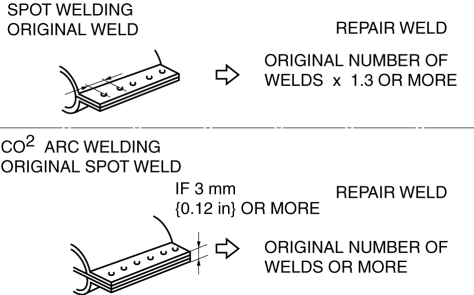
For the number of weld points, welding should be performed in accordance with the following reference standards.
Spot Welding Notes
-
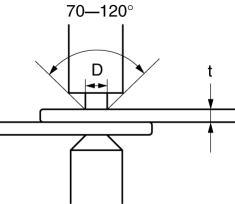
The shape of the spot welder tip is D=(2?t)+3. If the upper panel thickness is different from that of the under panel, adjust to the thinner one.
-
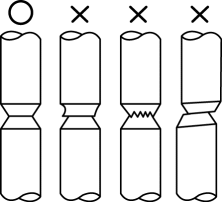
Because the weld strength is affected by the shape of the spot welder tip, the optimum condition of the tip should always be maintained.
-
Spot welds should be made at points other than the originally welded points.
-
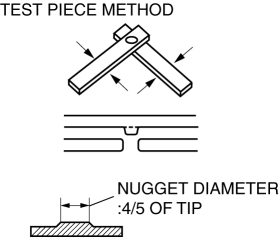
Before spot welding, make a trial weld using the same material as the body panel to check the weld strength.
Checking Weld Strength
-
Installation locations of the engine, chassis, and seat belts are designated as important safety locations for weld strength. Check weld strength by driving a chisel between the panels at every fourth or fifth weld spot, and every tenth regular weld location.
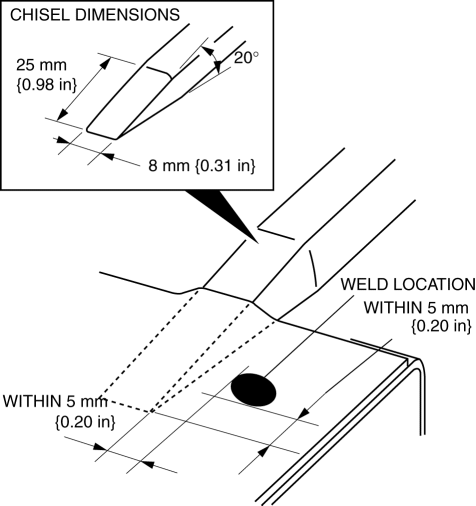
-
Drive the chisel between the panels according to the number of panels as shown below.
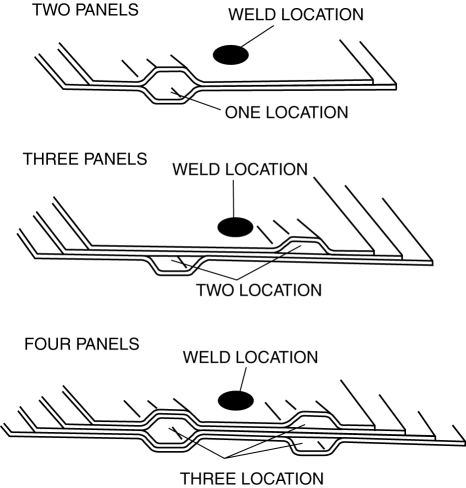
-
To determine weld strength, drive the chisel between the panel and check whether the panels come apart. If the panels come apart, make another weld near the original weld.
-
Restore the shape of the checked area.
 D Pillar Reinforcement (Lower) Removal [Panel Replacement]
Symbol Mark
Removal Procedure
1. Drill the 8 locations shown in the figure.
2. Remove the D-pillar reinforcement (lower). ...
 Efficient Removal Of Body Panels
Body Measurements
Before removal or rough?cutting, first measure the body at and around the
damaged area against the standard reference dimension specifications. If there
is deformation, ...
Other materials:
Brake
Brake System
Foot Brake
Your Mazda has power-assisted brakes that adjust automatically through normal
use.
Should power-assist fail, you can stop by applying greater force than normal
to the brake pedal. But the distance required to stop will be greater than usual.
WARNING
Do not coast wi ...
Not P Position Switch Inspection
NOTE:
The not P position switch is built into the selector lever component.
1. Disconnect the negative battery cable..
2. Remove the front console..
3. Disconnect the selector lever component connector.
4. Verify that the continuity between selector lever component terminals ...
Dynamic Stability Control (DSC)
The Dynamic Stability Control (DSC) automatically controls braking and engine
torque in conjunction with systems such as ABS and TCS to help control side slip
when driving on slippery surfaces, or during sudden or evasive maneuvering, enhancing
vehicle safety.
Refer to ABS and TCS .
DS ...
