
Mazda CX-5 Service & Repair Manual: Compression Inspection
WARNING:
-
Hot engines and oil can cause severe burns. Be careful not to burn yourself during removal/installation of each component.
-
Fuel vapor is hazardous. It can very easily ignite, causing serious injury and damage. Always keep sparks and flames away from fuel.
-
Fuel line spills and leakage are dangerous. Fuel can ignite and cause serious injuries or death and damage. Fuel can also irritate skin and eyes. To prevent this, always complete the “Fuel Line Safety Procedure”..
1. Verify that the battery is fully charged..
-
Recharge it if necessary..
2. Warm up the engine to the normal operating temperature.
3. Perform “Fuel Line Safety Procedures”..
4. Remove the following parts.
a. Plug hole plate..
b. Ignition coil/ion sensors..
c. Spark plugs..
d. Fuel pump relay
e. Fuel injector relay
5. Measure the compression pressure using the following procedure.
a. Press a compression gauge into the spark plug hole.
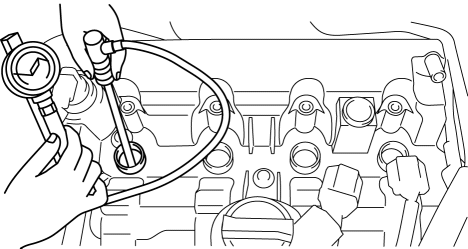
b. Fully depress the accelerator pedal.
c. Crank the engine and measure the compression pressure.
-
Compression
-
Standard: 885 kPa {9.02 kgf/cm2, 128 psi} [300 rpm]
-
Minimum: 708 kPa {7.22 kgf/cm2, 103 psi} [300 rpm]
-
Maximum difference between cylinders: 150 kPa {1.53 kgf/cm2, 21.8 psi}
NOTE:
-
Because the SKYACTIV-G 2.0 retards the intake valve closing timing, compression pressure is low.
d. Perform Steps (1) to (3) for all cylinders.
e. If it is less than the minimum specification, or there is a cylinder with a maximum value that exceeds the other cylinders, add a small quantity of engine oil through the spark plug hole and perform Steps (1) to (3).
-
If the pressure increases by adding the engine oil, the piston ring or the cylinder surface is worn, or they are damaged. Perform overhaul servicing.
-
If the pressure does not increase, valve seizure, valve attachment malfunction, or pressure leakage from the cylinder head gasket might be occurring. Perform overhaul servicing.
f. If the measured value is high, it is possible that there is an error in the electric variable valve timing system.
6. Remove the compression gauge.
7. Install the following parts.
a. Fuel injector relay
b. Fuel pump relay
c. Spark plugs..
d. Ignition coil/ion sensors..
e. Plug hole plate..
 General
...
 Compression Inspection
WARNING:
Hot engines and oil can cause severe burns. Be careful not to burn yourself
during removal/installation of each component.
Fuel vapor is hazardous. It can very easily ignit ...
Other materials:
Controller Area Network (Can)
Outline
The DSC HU/CM sends and receives data to and from other modules via the CAN
system. Refer to MULTIPLEX COMMUNICATION SYSTEM for a detailed explanation of
the CAN system..
Data sent
Cruise control system-related information
DSC system-related information
...
Rain Sensor
Outline
The rain sensor detects the amount of rainfall and calculates the wiper operation
speed, and outputs a windshield wiper control signal to the front body control
module (FBCM) to perform automatic wiper operation (auto wiper system) according
to the amount of rainfall.
...
Front Door Key Cylinder Switch Inspection
1. Perform the front door glass preparation..
2. Disconnect the negative battery cable..
3. Remove the following parts:
a. Inner garnish.
b. Front door trim.
c. Front door key cylinder.
d. Front door glass.
e. Front door module panel.
f. Front door latch and lock actuator.
Front Do ...
