
Mazda CX-5 Owners Manual: Location of the Tire Label (Placard)
You will find the tire label containing tire inflation pressure by tire size and other important information on the driver's side B-pillar or on the edge of the driver's door frame.
SAMPLE
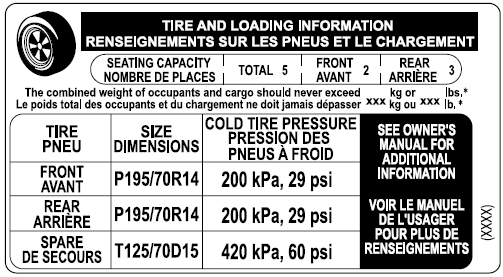
Recommended Tire Inflation Pressure
On the tire label you will find the recommended tire inflation pressure in both kPa and psi for the tires installed as original equipment on the vehicle. It is very important that the inflation pressure of the tires on your vehicle is maintained at the recommended pressure.
You should check the tire pressure regularly to insure that the proper inflation pressure is maintained.
NOTE
Tire pressures listed on the vehicle placard or tire information label indicate the recommended cold tire inflation pressure, measured when the tires are cold, after the vehicle has been parked for at least 3 hours. As you drive, the temperature in the tire warms up, increasing the tire pressure.
WARNING
Always check the tire inflation pressures on a regular basis according to the recommended tire inflation pressure on the tire label and in conjunction with the information in this owner's manual:
Driving your vehicle with under-inflated tires is dangerous.
Under-inflation is the most common cause of failures in any kind of tire and may result in severe cracking, tread separation or “blowout”, with unexpected loss of vehicle control and increased risk of injury. Under-inflation increases sidewall flexing and rolling resistance, resulting in heat buildup and internal damage to the tire. It results in unnecessary tire stress, irregular wear, loss of control and accidents. A tire can lose up to half of its air pressure and not appear to be flat! It is impossible to determine whether or not tires are properly inflated just by looking at them.
Checking Tire Pressure
1. When you check the air pressure, make sure the tires are cold ―meaning they are not hot from driving even a mile.
2. Remove the cap from the valve on one tire.
3. Firmly press a tire gauge onto the valve.
4. Add air to achieve recommended air pressure.
5. If you overfill the tire, release air by pushing on the metal stem in the center of the valve. Then recheck the pressure with your tire gauge.
6. Replace the valve cap.
7. Repeat with each tire, including the spare.
NOTE
Some spare tires require higher inflation pressure
8. Visually inspect the tires to make sure there are no nails or other objects embedded that could poke a hole in the tire and cause an air leak.
9. Check the sidewalls to make sure there are no gouges, cuts, bulges, cracks or other irregularities.
Glossary of Terms
Tire Placard:
A label indicating the OE tire sizes, recommended inflation pressure, and the maximum weight the vehicle can carry.
Tire Identification Number (TIN)
: A number on the sidewall of each tire providing information about the tire brand and manufacturing plant, tire size, and date of manufacture.
Inflation Pressure:
A measure of the amount of air in a tire.
kPa:
Kilopascal, the metric unit for air pressure.
psi:
Pounds per square inch, the English unit for air pressure.
B-pillar
: The structural member at the side of the vehicle behind the front door.
Original Equipment (OE):
Describes components originally equipped on the vehicle.
Vehicle Load Limit:
The maximum value of the combination weight of occupants and cargo.
Bead Area of the Tire:
Area of the tire next to the rim.
Sidewall Area of the Tire:
Area between the bead area and the tread.
Tread Area of the Tire:
Area on the perimeter of the tire that contacts the road when it's mounted on the vehicle.
Seating capacity
means the total allowable number of vehicle occupants. Seating capacity is described on the tire label.
Production options weight
is the combination weight of installed regular production options weighing over 2.3 kilograms in excess of the standard items which they replace, and not previously considered in the curb weight or accessory weight, including heavy duty brakes, ride levelers, roof rack, heavy duty battery, and special trim.
Rim
is the metal support (wheel) for a tire or a tire and tube assembly upon which the tire beads are seated.
 Tire Labeling
Federal law requires tire manufacturers to place standardized information on
the sidewall of all tires. This information identifies and describes the fundamental
characteristics of the tire and al ...
 Tire Maintenance
Improper or inadequate vehicle maintenance can cause tires to wear abnormally.
Here are some important maintenance points:
Tire Inflation Pressure
Inspect all tire pressure monthly (including the ...
Other materials:
Warm Up Three Way Catalytic Converter (Wu Twc) Inspection
CAUTION:
Perform the following procedures, DTC P0421:00 is indicated only.
1. Connect the M-MDS to the DLC-2.
2. Start the engine and warm it up to normal operating temperature.
3. Turn off the engine.
4. Verify that the engine compression is within the specification..
If ...
Transaxle Fluid Temperature (Tft) Sensor [Fw6 A EL, Fw6 Ax EL]
Purpose/Function
The transaxle fluid temperature (TFT) sensor detects the ATF temperature
in the oil pan.
The transaxle fluid temperature (TFT) sensor signal is used for automatic
shift control, TCC control, line pressure control, direct electric shift control,
learning contr ...
Magnetic Clutch Disassembly/Assembly [Full Auto Air Conditioner]
1. Disassemble in the order indicated in the table.
1
Bolt
(See Bolt Removal/Installation Note.)
2
Pressure plate
3
Shim
(See Shim Installation Note.)
4
Snap ring
(See Snap Ring ...
