
Mazda CX-5 Service & Repair Manual: Evaporator
Purpose
-
The evaporator cools the passing air.
Function
-
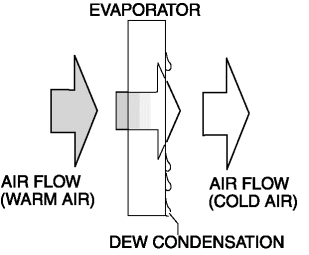
The evaporator vaporizes the atomized refrigerant flowing internally, and the air passing through the evaporator is cooled by the release of latent heat. The moisture in the air is condensed at this time and dehumidified air is blown into the cabin.
Construction
-
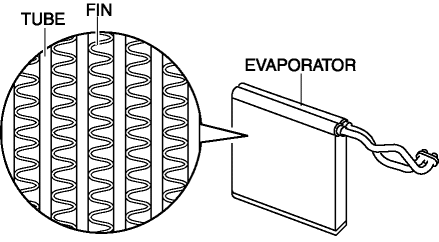
The evaporator consists of the tube which passes refrigerant, and the heat radiation fin.
-
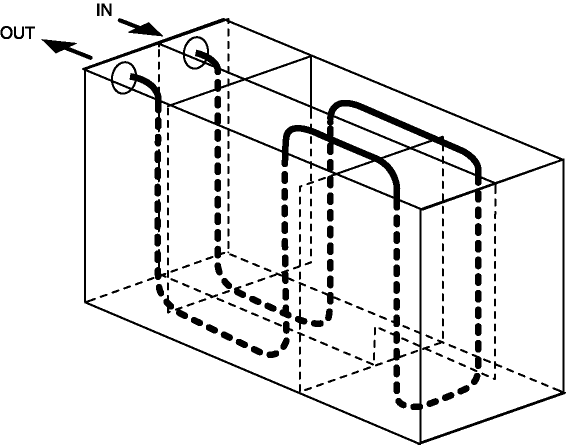
The cooling medium flow pattern shown in the figure has been adopted for the evaporator.
Operation
-
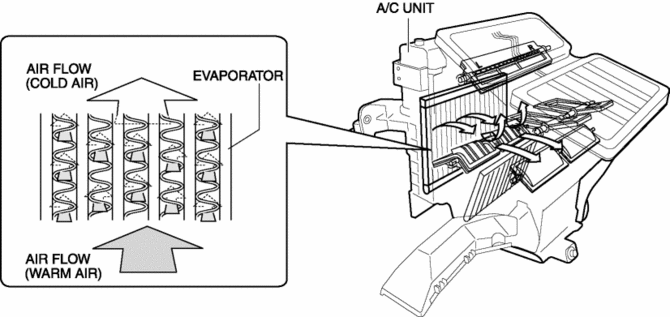
The atomized refrigerant sent from the expansion valve is captured by heat from the outside. As a result, the evaporator is cooled.
-
The air blown by the blower motor is cooled by heat exchange when it passes the heat radiation fin of the heater core.
Fail-safe
-
Function not equipped.
 Drive Belt [Skyactiv G 2.0]
Purpose, Function
The drive belt transmits rotation force of the crankshaft pulley to the pulley
for the auxiliary parts.
Construction
The drive belt is installed to the front o ...
 Evaporator Inspection
1. Inspect the evaporator for damage, cracks, and oil leakage.
If there is any malfunction, replace the evaporator.
2. Visually inspect the fins for bending.
If there is any bend ...
Other materials:
Brake
Brake System
Foot Brake
Your Mazda has power-assisted brakes that adjust automatically through normal
use.
Should power-assist fail, you can stop by applying greater force than normal
to the brake pedal. But the distance required to stop will be greater than usual.
WARNING
Do not coast wi ...
Thermostat Inspection
1. Remove the thermostat..
2. Visually check that the thermostat valve is closed.
3. Place the thermostat in water.
WARNING:
During inspection, the thermostat and water are extremely hot and can cause
severe burns. Do not touch the thermostat and water.
4. Heat the water and c ...
Rear ABS Wheel Speed Sensor Inspection [Awd]
Installation Visual Inspection
1. Inspect the following items:
If there is any malfunction, replace the applicable part.
a. Excessive play of the ABS wheel-speed sensor
b. Deformation of the ABS wheel-speed sensor
c. Deformation or damage of the ABS sensor rotor
Clearance Inspec ...
