
Mazda CX-5 Service & Repair Manual: Differential Oil Replacement
1. Place the vehicle on level ground.
2. Remove the filler plug.
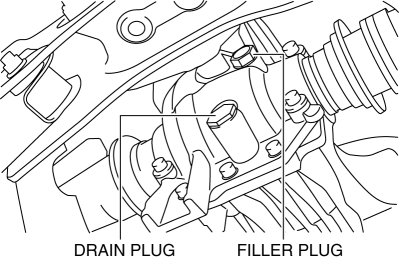
3. Remove the drain plug and drain the differential oil into a container.
4. Install a new washer and the drain plug, and tighten.
-
Tightening torque
-
40—53 N·m {4.1—5.4 kgf·m, 30—39 ft·lbf}
5. Add the specified differential oil from the filler plug until the level reaches the brim of the plug hole.
-
Rear differential oil
-
Specified oil grade: API service GL-5
-
Specified oil viscosity: SAE 80W-90
-
Capacity (approx. quantity): 0.45 L {0.48 US qt, 0.40 Imp qt}
6. After filling with differential oil, perform oil level inspection.
7. Install a new washer and the drain plug, and tighten.
-
Tightening torque
-
40—53 N·m {4.1—5.4 kgf·m, 30—39 ft·lbf}
 Differential Oil Inspection
1. Place the vehicle on level ground.
2. Remove the filler plug and washer.
3. Verify that the oil is at the brim of the filler plug hole.
4. If it is low, add the specified oil.
5. Instal ...
 Differential Oil Temperature Sensor
Purpose, Function
The differential oil temperature sensor detects the rear differential oil
temperature based on the resistance of the thermistor, and inputs it to the
AWD CM.
Const ...
Other materials:
Ambient Temperature Sensor [Full Auto Air Conditioner]
Purpose
The ambient temperature sensor detects the ambient temperature.
Function
The ambient temperature sensor converts the detected temperature to an electric
signal.
Construction
A thermistor-type ambient temperature sensor has been adopted.
The ambient ...
Forced Ignition On
NOTE:
In order to perform a forced ignition ON, the M-MDS is necessary. If the
servicing is being done outside of an Authorized Mazda dealership, contact an
Authorized Mazda dealership for instructions.
The forced ignition ON procedure forces a power supply to each part when
...
Steering Gear And Linkage Inspection
1. Remove the steering gear and linkage..
2. Remove the tie-rod end and boot..
3. Measure the rotation torque of the pinion shaft using a crescent wrench and
pull scale. (speed measurement reference 5 В°/s)
a. Install the crescent wrench to the steering gear.
b. Measure the length fr ...
