
Mazda CX-5 Service & Repair Manual: Auto Leveling Sensor Inspection
1. Disconnect the negative battery cable..
2. Remove the auto leveling sensor..
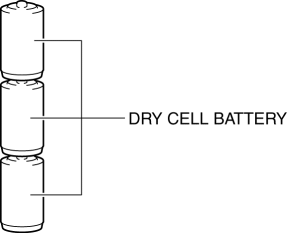
3. Prepare three dry cell batteries (1.5 V
).
4. Connect the three dry cell batteries in a series.
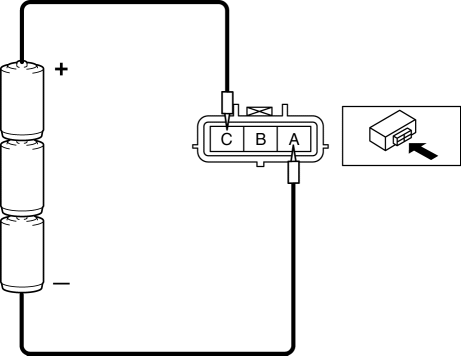
5. Connect the positive pole of the dry cell battery to auto leveling sensor terminal C, and the negative pole to terminal A.
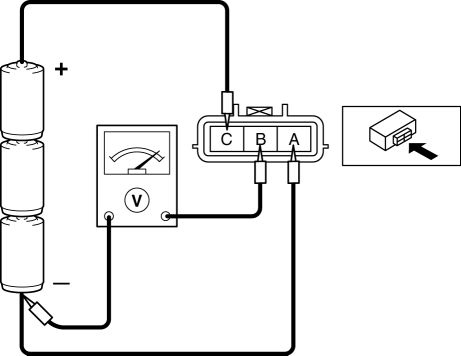
6. Connect the tester as shown in the figure with approx. 4.5 V
of voltage applied between auto leveling sensor terminals A and C, and measure the voltage at auto leveling sensor terminal B.
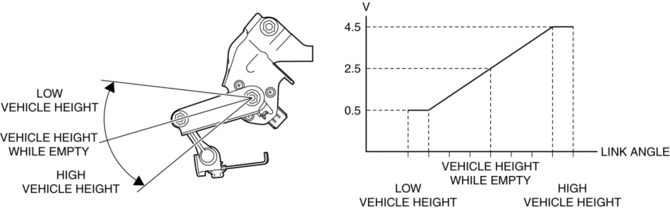
7. When slowly moving the auto leveling sensor link up and down, verify that the voltage fluctuates linearly between 0.5—4.5 V
as shown in the figure.
-
If the voltage cannot be verified as indicated in the graph, replace the auto leveling sensor.
 Auto Leveling Sensor
Purpose
Detects the vehicle height and outputs it to the AFS control module.
Function
Changes the detected vehicle height into a voltage value and outputs it to
the AFS control ...
 Auto Leveling Sensor Removal/Installation
1. Disconnect the negative battery cable..
2. Disconnect the connector.
3. Remove the bolts.
4. Remove the auto leveling sensor.
5. Install in the reverse order of removal.
6. Pe ...
Other materials:
Ebd Control
Outline
EBD control uses the ABS system to control brake fluid pressure distribution
to the rear wheels so that they do not lock-up prior to the front wheels during
braking, thereby preventing the loss of handling stability.
Feature
EBD control has independent control syste ...
Fuel Filler Pipe Removal/Installation
WARNING:
Fuel is very flammable liquid. If fuel spills or leaks from the pressurized
fuel system, it will cause serious injury or death and facility breakage. Fuel
can also irritate skin and eyes. To prevent this, always complete the “Fuel
Line Safety Procedure”, while referring ...
Fuel Tank Pressure Sensor Inspection
Voltage Inspection
NOTE:
The fuel tank pressure sensor cannot be removed as a single unit. When replacing
the fuel tank pressure sensor, replace it together with the charcoal canister
as a single unit.
1. Disconnect the negative battery cable..
2. Disconnect the fuel tank pres ...
