
Mazda CX-5 Owners Manual: Traction Control System (TCS)
The Traction Control System (TCS) enhances traction and safety by controlling engine torque and braking.
When the TCS detects driving wheel slippage, it lowers engine torque and operates the brakes to prevent loss of traction.
This means that on a slick surface, the engine adjusts automatically to provide optimum power to the drive wheels, limiting wheel spin and loss of traction.
A system malfunction or operation conditions are indicated by a warning.
Refer to Warning/Indicator Lights on .
WARNING
Do not rely on the traction control system as a substitute for safe driving:
The traction control system (TCS) cannot compensate for unsafe and reckless driving, excessive speed, tailgating (following another vehicle too closely), and hydroplaning (reduced tire friction and road contact because of water on the road surface). You can still have an accident.
Use snow tires or tire chains and drive at reduced speeds when roads are covered with ice and/or snow:
Driving without proper traction devices on snow and/or ice-covered roads is dangerous. The traction control system (TCS) alone cannot provide adequate traction and you could still have an accident.
NOTE
To turn off the TCS, press the TCS OFF switch .
TCS OFF Switch
Press the TCS OFF switch to turn off the TCS. The TCS OFF indicator light in the instrument cluster will illuminate.
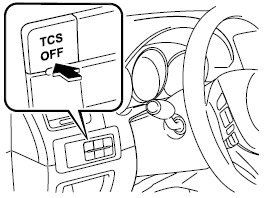
Press the switch again to turn the TCS back on. The TCS OFF indicator light will turn off.
NOTE
• When TCS is on and you attempt to free the vehicle when it is stuck, or drive it out of freshly fallen snow, the TCS will activate.
Depressing the accelerator will not increase engine power and freeing the vehicle may be difficult. When this happens, turn off the TCS.
• If the TCS is off when the engine is turned off, it automatically activates when the ignition is switched ON.
• Leaving the TCS on will provide the best traction.
• If the TCS OFF switch is pressed and held for 10 seconds or more, the TCS OFF switch malfunction detection function operates and the TCS system activates automatically. The TCS OFF indicator light turns off while the TCS system is operative.
 Antilock Brake System (ABS)
The ABS control unit continuously monitors the speed of each wheel. If one wheel
is about to lock up, the ABS responds by automatically releasing and reapplying
that wheel's brake.
The driver ...
 Dynamic Stability Control (DSC)
The Dynamic Stability Control (DSC) automatically controls braking and engine
torque in conjunction with systems such as ABS and TCS to help control side slip
when driving on slippery surfaces, or ...
Other materials:
Body Sealing [Water Proof And Rust Preventive]
Sealant is applied to the parts where the panels meet and to the hemmed parts
of the door panel and hood panel to provide water proofing and rust proofing.
...
Control Valve Body [Fw6 A EL, Fw6 Ax EL]
Purpose/Function
A direct linear solenoid has been adopted for the solenoid valve which contributes
to improved shift response, drive feel and reduced shift shock by the improved
precision of the hydraulic pressure control.
Construction
The control valve body consists of in ...
Tire Pressure Monitoring System (TPMS)
Purpose, Outline
The tire pressure monitoring system monitors the tire pressure of all 4 tires.
If the tire pressure of 1 tire or more becomes excessively low, the driver is
notified.
A tire pressure monitoring system has been adopted which indirectly inspects
the tire pres ...
