
Mazda CX-5 Service & Repair Manual: Tire Pressure Warning Alarm
Purpose
-
The tire pressure warning alarm warns the user that a tire pressure has decreased or notifies the user that the tire pressure warning alarm has been reset.
Function
-
If the instrument cluster receives a tire pressure warning alarm request signal sent from the DSC HU/CM via the CAN signal, the tire pressure warning alarm is sounded.
-
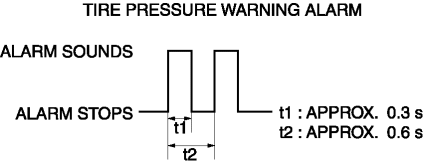
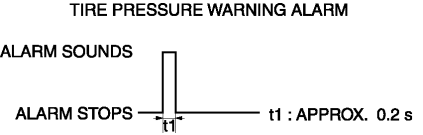
The tire pressure warning alarm sound pattern is as follows: For the conditions in which each alarm pattern sounds, refer to TIRE PRESSURE MONITORING SYSTEM (TPMS).
Tire pressure monitoring system operating
Tire pressure monitoring system initialization
Construction
-
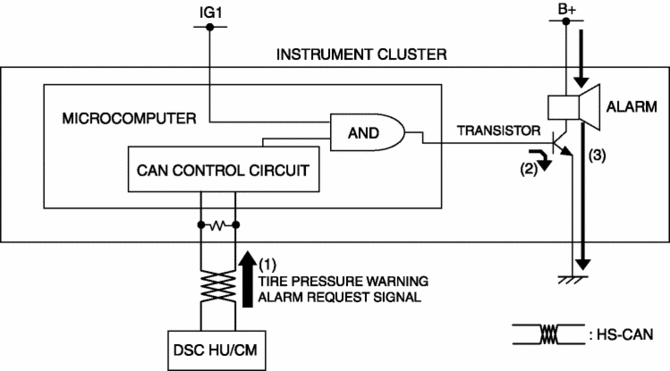
The tire pressure warning alarm sounds using the buzzer built into the instrument cluster.
Operation
1. The instrument cluster receives (1) the tire pressure warning alarm request signal from the DSC HU/CM.
2. The instrument cluster microcomputer turns the transistor on (2) based on the tire pressure warning alarm request signal.
3. When the transistor turns on, the ground circuit of the alarm is established and the alarm sounds (3).
Fail-safe
-
Function not equipped.
 Tire Pressure Monitoring System Warning Light
Purpose, Function
The tire pressure monitoring system warning light notifies the driver that
it was determined that a tire pressure has decreased below the specified value
based on the ...
Other materials:
Refrigerant Pressure Sensor [Full Auto Air Conditioner]
Purpose
The refrigerant pressure sensor detects the refrigerant pressure in the refrigerant
cycle.
Function
The refrigerant pressure sensor converts the detected refrigerant pressure
to an electric signal and sends it to the PCM.
Construction
The refriger ...
Charging System [Skyactiv G 2.0]
Outline
Regulator-less generator (built-in power transistor) has been adopted.
A generator using two delta connection type stator coils has been adopted.
Structural View
Structure
Consists of the following parts:
Battery
(See B ...
Power Window Main Switch Removal/Installation
1. Disconnect the negative battery cable..
2. Remove the cover A.
3. Insert a tape-wrapped fastener remover shown in the figure and remove the
tab B in the direction of arrow (1).
4. Slide the power window main switch cover in the direction of the arrow (2)
shown in the figure and ...
