
Mazda CX-5 Service & Repair Manual: Timing Chain, Chain Tensioner
Purpose, Function
Timing chain
-
The timing chain transmits the rotation force of the crankshaft to the camshaft to perform the rotation timing of the crankshaft and camshaft.
Chain tensioner
-
The chain tensioner constantly maintains the timing chain tension and the timing chain operation is stabilized.
Construction
Timing chain
-
The timing chain is installed between the camshaft sprocket and crankshaft sprocket.
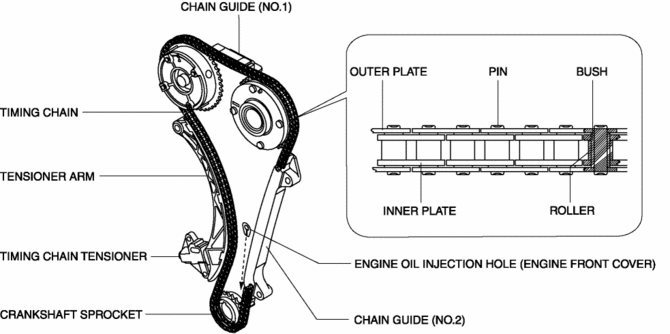
-
Lubrication of the timing chain and each sprocket is performed using the engine oil from the engine front cover.
-
Improvement of the rigidity of the chain guide and tensioner arm and the stability of the timing chain operation have reduced the sliding resistance.
Chain tensioner
-
The chain tensioner is installed to the cylinder block (engine front).
-
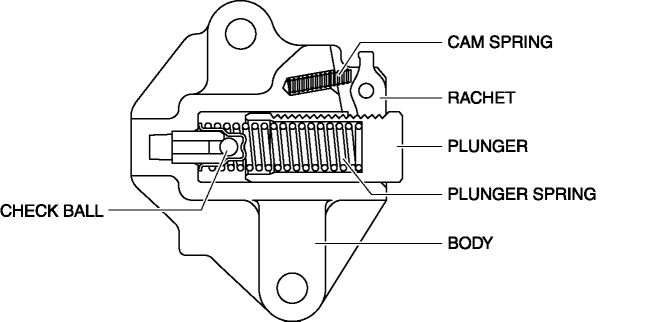
An oil pressure type chain tensioner has been adopted for the chain tensioner.
OPERATION
Chain tensioner
-
Fluctuation in the timing chain tension by oil pressure and spring force is suppressed, and the tension is maintained at a constant.
 Timing Chain Removal/Installation
WARNING:
A hot engine can cause severe burns. Turn off the engine and wait until it
is cool before servicing.
CAUTION:
If the camshaft is rotated with the timing chain removed ...
 Control
...
Other materials:
Differential Oil Temperature Sensor Removal/Installation
WARNING:
Hot differential oil may cause severe burns. Do not perform maintenance while
differential oil is hot.
1. Disconnect the negative battery cable.
2. Disconnect the differential oil temperature sensor connector.
3. Remove the differential oil temperature sensor.
4. ...
Condenser Removal/Installation
1. Disconnect the negative battery cable..
2. Remove the following parts:
a. Trunk board.
b. Trunk end trim (LH).
c. Rear scuff plate (LH).
d. Trunk side trim (LH).
e. D-pillar trim (LH).
3. Disconnect the connector.
4. Remove the bolts.
5. Remove the condenser.
6. Install in ...
Blind Spot Monitoring (Bsm) Off Switch
Purpose
The blind spot monitoring (BSM) system can be turned on or off optionally
by the driver.
Function
The switch operation signal is sent to the instrument cluster.
Construction
The BSM OFF switch is built into the cluster switch.
The resistance is bui ...
