
Mazda CX-5 Owners Manual: Scheduled Maintenance (Mexico)
Follow Schedule 1 if the vehicle is operated mainly where none of the following conditions apply.
• Repeated short-distance driving
• Driving in dusty conditions
• Driving with extended use of brakes
• Driving in areas where salt or other corrosive
materials are used
• Driving on rough or muddy roads
• Extended periods of idling or low-speed operation
• Driving for long periods in cold temperatures
or extremely humid climates
• Driving in extremely hot conditions
• Driving in mountainous conditions continually
If any do apply, follow Schedule 2.
NOTE
After the prescribed period, continue to follow the described maintenance at the recommended intervals.
Schedule 1
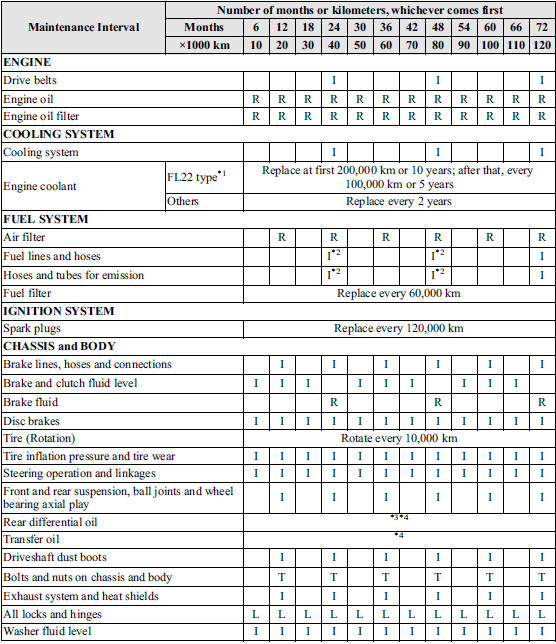

Chart symbols:
I: Inspect: Inspect and clean, repair, adjust, fill up, or replace if necessary.
R: Replace
•: Lubricate
T: Tighten
Remarks:
*1 Use FL22 type coolant in vehicles with the inscription “FL22” on the radiator cap itself or the surrounding area. Use FL22 when replacing the coolant.
*2 According to state/provincial and federal regulations, failure to perform maintenance on these items will not void your emissions warranties. However, Mazda recommends that all maintenance services be performed at the recommended time or kilometer period to ensure long-term reliability.
*3 If the vehicle is operated primarily under any of the following conditions, replace the rear differential oil at every 45,000 km.
a) Towing a trailer or using a car-top carrier b) Driving in dusty, sandy or wet conditions c) Extended periods of idling or low speed operation d) Repeated short trips of less than 16 km *4 If this component has been submerged in water, the oil should be replaced.
Schedule 2
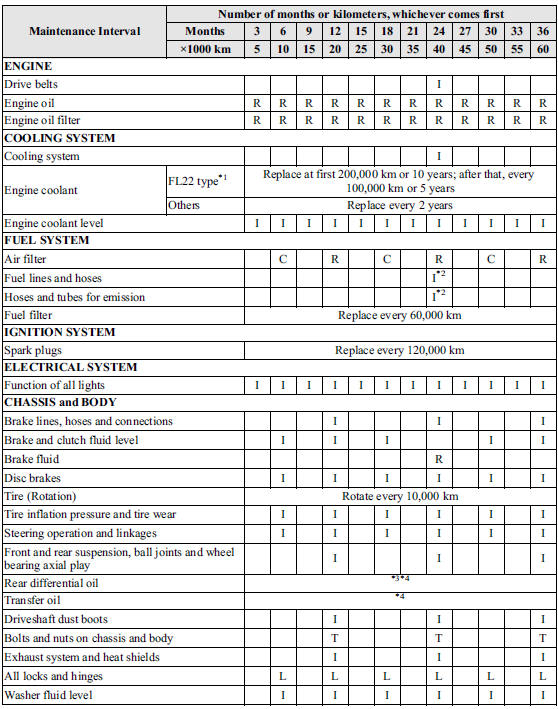

Chart symbols:
I: Inspect: Inspect and clean, repair, adjust, fill up, or replace if necessary.
R: Replace
L : Lubricate
C: Clean
T: Tighten
Remarks:
*1 Use FL22 type coolant in vehicles with the inscription “FL22” on the radiator cap itself or the surrounding area. Use FL22 when replacing the coolant.
*2 According to state/provincial and federal regulations, failure to perform maintenance on these items will not void your emissions warranties. However, Mazda recommends that all maintenance services be performed at the recommended time or kilometer period to ensure long-term reliability.
*3 If the vehicle is operated primarily under any of the following conditions, replace the rear differential oil at every 45,000 km.
a) Towing a trailer or using a car-top carrier b) Driving in dusty, sandy or wet conditions c) Extended periods of idling or low speed operation d) Repeated short trips of less than 16 km *4 If this component has been submerged in water, the oil should be replaced.


Chart symbols:
I: Inspect: Inspect and clean, repair, adjust, fill up, or replace if necessary.
R: Replace
L: Lubricate
C: Clean
T: Tighten
Remarks:
*1 Use FL22 type coolant in vehicles with the inscription “FL22” on the radiator cap itself or the surrounding area. Use FL22 when replacing the coolant.
*2 According to state/provincial and federal regulations, failure to perform maintenance on these items will not void your emissions warranties. However, Mazda recommends that all maintenance services be performed at the recommended time or kilometer period to ensure long-term reliability.
*3 If the vehicle is operated primarily under any of the following conditions, replace the rear differential oil at every 45,000 km.
a) Towing a trailer or using a car-top carrier b) Driving in dusty, sandy or wet conditions c) Extended periods of idling or low speed operation d) Repeated short trips of less than 16 km *4 If this component has been submerged in water, the oil should be replaced.
 Scheduled Maintenance (U.S.A., Canada, and Puerto Rico)
Follow Schedule 1 if the vehicle is operated mainly where none of the following
conditions apply.
• Repeated short-distance driving
• Driving in dusty conditions
• Driving with extended use ...

Other materials:
Canister Vent (Cv) Solenoid Valve Inspection
U.S.A. And CANADA
Airflow inspection
1. Disconnect the negative battery cable..
2. Remove the CV solenoid valve..
3. Inspect airflow between the ports under the following conditions.
Measured condition
Continuity between A—B
When volta ...
Front Body Control Module (Fbcm) Configuration (Using Read/Write Function)
NOTE:
When performing configuration, it is necessary to read the vehicle specification
information from the front body control module (FBCM) before replacing it. Connect
the M-MDS to the vehicle and perform vehicle identification before removing
the front body control module (FBCM). ...
Seat Warmer System
Purpose
The seat warmer system warms the front seat cushion and front seat back using
the seat warmer unit.
Function
The seat warmer unit warms the seat cushion and seat back by supplying power
to the built-in filaments.
The seat warmer unit can adjust the tempe ...
