
Mazda CX-5 Service & Repair Manual: Refrigerant Charging
CAUTION:
-
Do not use a different type of refrigerant or charge beyond the specified level. Otherwise, cooling ability will be lowered and the A/C compressor could be damaged.
Charging Recycled HFC-134a Refrigerant
1. Connect an HFC-134a recovery/recycling/recharging device to the vehicle and follow the device manufacturer’s instructions.
Charging Preparation
1. Install the manifold gauge set.
2. Connect the tap pin side of the charging hose to the air purge valve of the manifold gauge.
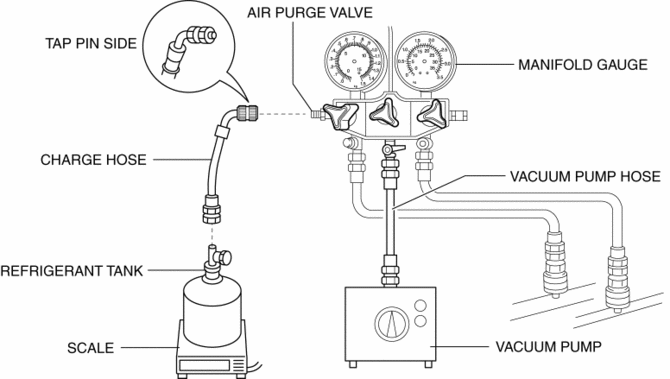
3. Connect the vacuum pump hose to the center joint of the manifold gauge.
4. Connect the vacuum pump hose to the vacuum pump.
5. Connect the charging hose to the refrigerant tank.
6. Place the refrigerant tank on the scale.
-
Regular amount of refrigerant (approx. quantity)
-
465—515
g {16.5—18.1
oz}
Evacuation
1. Open all the valves of the manifold gauge.
CAUTION:
-
Close the manifold gauge valve immediately after stopping the vacuum pump. If the valve is left open, the vacuum pump oil will back flow into the refrigeration cycle and cause a decrease in the efficiency of the air conditioner.
2. Start the vacuum pump and let it operate for 15 min
.
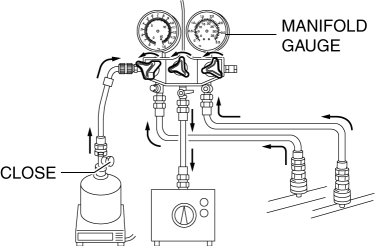
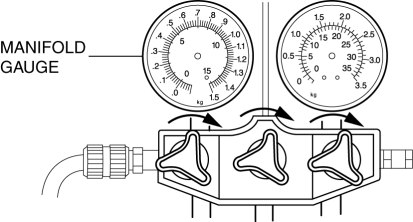
3. Verify that high? and low-pressure side readings of the manifold gauge are at –101 kPa {–1.03 kgf/cm2, –14.6 psi}
. Close each valve of the manifold gauge.
Airtightness Check
1. Stop the vacuum pump and wait for 5 min
.
2. Check the high? and low-pressure side readings of the manifold gauge.
-
If the reading has changed, inspect for leakage and go to Evacuation..
-
If the reading has not changed, go to Charging New R-134a Refrigerant..
Charging New HFC-134a Refrigerant
1. Open the valve of the refrigerant tank.
2. Weigh the refrigerant tank to charge the suitable amount of refrigerant.
WARNING:
-
If the refrigerant system is charged with a large amount of refrigerant when inspecting for gas leakage, and if any leakage should occur, the refrigerant will be released into the atmosphere. In order to prevent the accidental release of refrigerant which can destroy the ozone layer in the stratosphere, follow the proper procedures and charge with only a small amount of refrigerant when inspecting for gas leakage.
-
If charging the system with refrigerant using service cans, running the engine with the high-pressure side valve open is dangerous. Pressure within the service cans will increase and the cans could explode, scattering metal fragments and liquid refrigerant that can seriously injure you. Therefore, do not open the high-pressure side valve while the engine is running.
3. Open the low-pressure side valve of the manifold gauge.
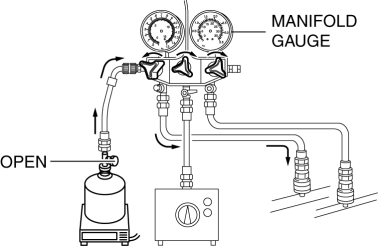
4. When the high-pressure side reading increases to 0.098 MPa {1.0 kgf/cm2, 14 psi}
, close the low-pressure side valve of the manifold gauge.
5. Inspect for leakage from the cooler pipe/hose connections using the gas leak tester.
-
If there is no leakage, go to Step 7.
-
If leakage is found at a loose joint, tighten the joint, then go to next step.
6. Inspect for leakage again.
-
If there is no leakage after tightening the joint, go to next step.
-
If there is still a leakage at the same joint, discharge the refrigerant and then repair the joint. Repeat the charging procedure from evacuation.
WARNING:
-
If charging the system with refrigerant using service cans, running the engine with the high-pressure side valve open is dangerous. Pressure within the service cans will increase and the cans could explode, scattering metal fragments and liquid refrigerant that can seriously injure you. Therefore, do not open the high-pressure side valve while the engine is running.
7. Open the low-pressure side valve of the manifold gauge and charge with refrigerant until the weight of refrigerant tank has decreased 250 g {8.82 oz}
from the amount in Step 2.
8. Close the low-pressure side valve of the manifold gauge.
WARNING:
-
If charging the system with refrigerant using service cans, running the engine with the high-pressure side valve open is dangerous. Pressure within the service cans will increase and the cans could explode, scattering metal fragments and liquid refrigerant that can seriously injure you. Therefore, do not open the high-pressure side valve while the engine is running.
9. Start the engine and actuate the A/C compressor.
10. Open the low-pressure side valve of the manifold gauge and charge with refrigerant until the weight of the refrigerant tank has decreased regular amount from the amount in Step 2.
11. Close the low-pressure side valve of the manifold gauge and the valve of the refrigerant tank.
12. Stop the engine and A/C compressor.
Leak Test
1. Inspect for leakage using the gas leak tester.
-
If there is no leakage, go to Step 3.
-
If leakage is found at a loose joint, tighten the joint, then go to the next step.
2. Inspect for leakage again.
-
If there is no leakage after tightening the joint, go to the next step.
-
If there is still leakage at the same joint, discharge the refrigerant and then repair the joint. Repeat the charging procedure from evacuation.
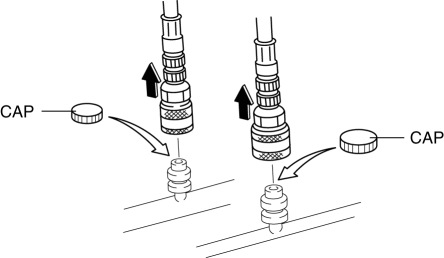
3. Disconnect the quick couplers from the charging valves.
4. Install the caps to the charging valves.
 Receiver/Drier Removal/Installation
1. Disconnect the negative battery cable..
2. Discharge the refrigerant..
3. Remove the front under cover No.1..
4. Drain the engine coolant..
5. Remove the following parts:
a. Plug hole pla ...
 Refrigerant Line
Purpose
The system piping connects each related part of the refrigerant system.
Construction
Block-type piping has been adopted to the pipe connection, improving the
efficiency ...
Other materials:
Air Bag Module And Pre Tensioner Seat Belt Deployment Procedures [Standard Deployment
Control System]
WARNING:
A live (undeployed) air bag module or pre-tensioner seat belt may accidentally
operate (deploy) when it is disposed of and cause serious injury. Do not dispose
of a live (undeployed) air bag module or pre-tensioner seat belt. If the SSTs
(Deployment tool and Adapter harness ...
Presilencer
Purpose, Function
Reduces the exhaust noise.
Construction
The presilencer is installed to the rear of the TWC.
2WD
AWD
The presilencer consists of the filters, stuffing and wool-stainless.
2WD
AWD
...
Accelerator Pedal, Kickdown Switch [Skyactiv G 2.0]
Purpose, Function
The driver's intentions are transmitted to the PCM via the accelerator pedal.
Kickdown switch (ATX) (Applied VIN (assumed): JM3 KE2*E*D# 148107?)
If the accelerator pedal is depressed carelessly, kickdown control will be
implemented based on the accelera ...
